Select a site alphabetically from the choices shown in the box below. Alternatively, browse sculptural examples using the Forward/Back buttons.
Chapters for this volume, along with copies of original in-text images, are available here.


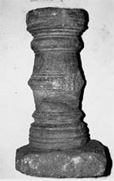
Object type: Baluster, in two joining pieces
Measurements: H. 57.7 cm (22.6 in); W. (max.) 31 cm (12.25 in); D. (max.) 28.8 cm (11.3 in); Diameter of shaft (max.) 19.6 cm (7.75 in)
Stone type: Greyish-yellow (10YR 8/2–3), medium-grained oolitic limestone, with ooliths 0.3–0.5 mm in diameter, close-packed in a finely oolitic or pellety matrix of 0.1–0.2 mm particles; Marquise stone, Oolithe de Marquise Formation, Bathonian, Middle Jurassic; Boulonnais, France
Plate numbers in printed volume: Ills. 41-45
Corpus volume reference: Vol 4 p. 132-133
(There may be more views or larger images available for this item. Click on the thumbnail image to view.)
The placing of deep nicks on opposite sides and opposite ends of the shaft is suggestive not of accidental damage, but rather of a deliberate attempt to break up the baluster; indeed, the lower nick caused the baluster to break into two. The hollows on the ends (Ills. 44–5) were designed to accommodate the mandrels of the lathe on which the baluster was turned.
This piece is similar, but not identical, to the baluster from Dover (St Mary in Castro) nos. 2–3 (Ills. 64–7, 71–5). The Dover fragments may be contemporary with the surviving late Anglo-Saxon fabric of the church; it is possible that there was originally a belfry stage to the central tower, which was remodelled in the thirteenth century. One of the balusters at Dover (no. 3b; Ill. 80) is recut to form a section of early Gothic moulding, probably a vault rib. Certainly where turned balusters of this general type occur in south-east England, as at Oxford (St Michael) no. 1 (Ills. 364–70), they are probably of late Anglo-Saxon date.
