Volume 4: South-East England
Select a site alphabetically from the choices shown in the box below. Alternatively, browse sculptural examples using the Forward/Back buttons.
Chapters for this volume, along with copies of original in-text images, are available here.
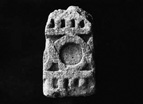
Current Display: Winchester (Old Minster) 47, Hampshire


Overview
Object type: Part of frieze
Measurements: H. 27 > 22 cm (10.6 > 8.7 in); W. 15 > 12.5 cm (5.9 > 4.9 in); D. 19.5 > 15 cm (7.7 > 5.9 in)
Stone type: Yellowish-grey, medium- to coarse-grained, very shelly, oolitic limestone, bedding parallel to the long axis of the stone; Combe Down Oolite, Great Oolite Formation of the Bath area, Great Oolite Group, Middle Jurassic
Plate numbers in printed volume: Ills. 576-578
Corpus volume reference: Vol 4 p. 296-297
(There may be more views or larger images available for this item. Click on the thumbnail image to view.)
Present Location
Winchester City Museum, Historic Resources Centre, Hyde House, Winchester, accessions no. 2943 WS 468
Evidence for Discovery
Found in archaeological excavation north of Winchester cathedral in 1965 reused in furnace wall of Norman bell-foundry; Final Phase 64 (Provisional Phase 678), early twelfth-century
Church Dedication
Old Minster
Present Condition
One original bed face (F, bottom) survives; a secondary diagonal dressed face (chamfer?) has been cut across the top. The left side of the stone (face B) has been trimmed back to ashlar size. The carv
Description
A: Three horizontal elements have survived. The central element consists of circles, diameter 10 cm, formed by the interweaving loops of two ribbons of rectangular section. Above and below there are dentil patterns, that below being c. 7.5 cm wide with dentils 3 cm high, formed by rectangular slots, 1 cm in width, the bottom angled. The pattern above was probably similar.
F: On the bottom bed face, about 2 cm behind the carved face and parallel to it, there is a groove, 3 mm deep, like that on Winchester (Old Minster) no. 44 and perhaps on Winchester (Old Minster) no. 37.
Discussion
This is the best preserved section of the frieze, a variation of which is seen in Winchester (Old Minster) no. 44, and perhaps in no. 37. The pattern also occurs on no. 48 (found near the present piece) and on no. 49 (no provenance). The scroll has survived on nos. 45–6. Together these stones would make a border or string at least 80 cm long and 25 cm high. It is one of several types of border patterns or friezes with dentition which are comparable to miniature baluster patterns found at Jarrow and dated to the late seventh or early eighth century (Cramp 1984, i, 118–20, ii, pls. 101–2). Seven of the Winchester pieces of this type, Winchester (Old Minster) nos. 36–7, WS 445 (see no. 37), 38, 40, 42 and 44, come from immediately above or near the Old Minster baptistery, and could well have derived from the original mid seventh-century decoration of this part of the church. Nos. 45, 47, and 48, are from further east but could still have come from the seventh- or eighth-century east end. No. 46 is from the west end. H. M. Taylor discusses and analyses string-courses in churches established as Anglo-Saxon on primary or secondary evidence (Taylor and Taylor 1965–78, iii, 902–14, figs. 696–8). Winchester (Old Minster) no. 47, with its height of over 27 cm, would be taller than the sculptured string-course from Monkwearmouth, co. Durham, no. 12 (height c. 24 cm), and more than twice as tall as those from Hexham, Northumberland, nos. 36–7 (Cramp 1984, i, 127–8, 191, ii, pls. 117 (621–5), 185 (1016–17)); but the present stone is much smaller than the string-course from Barnack, Northamptonshire, which is 56 cm high and is carved on a single stone across the inner face of the west wall. Barnack was probably built before the end of the ninth century (Taylor and Taylor 1965–78, i, 303). Winchester (Old Minster) nos. 36–8, 40, 42, and 44–9 are best placed amongst Taylor's 'special' string-courses, which include sculpted examples from churches of a wide date range. Special string-courses occurred in five of 88 cases (six per cent).
Date
Seventh century or later
References
Biddle and Kjølbye-Biddle forthcoming a, fig. 146, no. 47
M.B.; B.K.-B.
Endnotes