Volume 4: South-East England
Select a site alphabetically from the choices shown in the box below. Alternatively, browse sculptural examples using the Forward/Back buttons.
Chapters for this volume, along with copies of original in-text images, are available here.
Current Display: Canterbury (St Augustine's Abbey) 08, Kent 

Overview
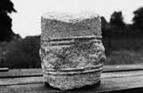
Object type: Part of baluster
Measurements: H. 24 cm (9.5 in); Diameter 20 cm (8 in)
Stone type: Not obtained
Plate numbers in printed volume: Ill. 50
Corpus volume reference: Vol 4 p. 133
(There may be more views or larger images available for this item. Click on the thumbnail image to view.)
Present Location
Historic Buildings and Monuments Commission Stores, Dover castle (not currently available)
Evidence for Discovery
Removed from nineteenth-century boundary wall of old County Hospital, overlying south side of St Augustine's abbey church, in front of old mortuary
Church Dedication
St Augustine's abbey
Present Condition
Extensively damaged; unweathered
Description
Roughly broken above and below. There is a broad median roll moulding, largely broken or dressed away. To each side it is flanked by two narrow roll mouldings separated by deep grooves.
Discussion
The lack of taper and the use of narrow grooving are features not encountered among the late Anglo-Saxon balusters of the region. These features are, however, found consistently on early lathe-turned balusters in Northumbria, as at Jarrow, co. Durham, where there are twenty-five, and Monkwearmouth, where there are thirty (Cramp 1984, i, 120–1, 128–9). A late seventh-century date can plausibly be argued for this series, since four of the Monkwearmouth examples are in situ in the west porch (Cramp 1984, ii, pls. 112–15), which is generally agreed to have been a very early addition to the first church on the site, founded in 674 (Taylor and Taylor 1965–78, i, 433, 437–9, fig. 204). A similar date may be argued by analogy for the present example.
Date
Seventh century
References
Tweddle 1986b, i, 133
D.T.
Endnotes
