Select a site alphabetically from the choices shown in the box below. Alternatively, browse sculptural examples using the Forward/Back buttons.
Chapters for this volume, along with copies of original in-text images, are available here.


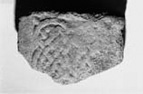
Object type: Grave-cover or panel
Measurements: L. 15 cm (5.9 in); W. 31.5 cm (12.4 in); D. 9 cm (3.5 in)
Stone type: Greyish-yellow, orange-flecked, oolitic and pellety limestone with shell fragments; of uncertain provenance, possibly an ironshot limestone from the Great Oolite Formation of the Bath area, Great Oolite Group, Middle Jurassic
Plate numbers in printed volume: Ills. 51-53
Corpus volume reference: Vol 4 p. 133-134
(There may be more views or larger images available for this item. Click on the thumbnail image to view.)
It is sub-rectangular, with a broad, plain, low relief border to the left and right, and a similar, narrower border at the upper end. The lower end is roughly broken. Only one face is carved.
A: This face is slightly convex and is decorated with a neatly laid out but worn interlace, surrounded pattern D.
B and C: The two surviving edges of the stone are smoothly dressed.
This may be one of the 'smaller fragments' of sculpture discovered during Hope's excavations built into the base of the Romanesque screen overlying the western part of Wulfric's rotunda. There is no direct mention of it in his account of his work, however. See also Canterbury, K. (St Augustine's abbey) no. 3, above.
The simplest way to reconstruct this piece is as one end of a rectangular slab. The damage to the sides makes it difficult to decide whether the long edges were originally parallel, or whether the stone tapered.
The stone could originally have served any one of a number of functions, for example, as a decorative architectural panel or closure slab, but the convexity of face A is more reminiscent of the treatment of grave-covers. A number of relatively narrow covers are known from south-east England, for example, several of those from Chithurst, Sussex. The depth of the St Augustine's slab is also typical of grave-covers from the region, which tend to be around 10 cm deep.
The dating of the stone is based on the type of interlace pattern employed, and the thickness of the strand; these features are of a type normally associated with late Anglo-Saxon sculpture.
