Volume 4: South-East England
Select a site alphabetically from the choices shown in the box below. Alternatively, browse sculptural examples using the Forward/Back buttons.
Chapters for this volume, along with copies of original in-text images, are available here.
Current Display: Winchester (Old Minster) 59, Hampshire 

Overview
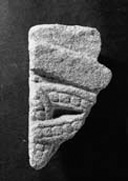
Object type: Fragment of frieze(?)
Measurements: H. 18.5 > 7 cm (7.3 > 2.8 in); W. 10 > 2 cm (3.9 > 0.8 in); D. 9.5 > 2 cm (3.8 > 0.8 in)
Stone type: Pale yellowish-grey, medium-grained, shelly, oolitic limestone; Combe Down Oolite, Great Oolite Formation of the Bath area, Great Oolite Group, Middle Jurassic
Plate numbers in printed volume: Ills. 597-598
Corpus volume reference: Vol 4 p. 302
(There may be more views or larger images available for this item. Click on the thumbnail image to view.)
Present Location
Winchester City Museum, Historic Resources Centre, Hyde House, Winchester, accessions no. 2943 WS 202
Evidence for Discovery
Found in archaeological excavation north of Winchester cathedral in 1964 in a masons' chipping layer above robbed baptistery of Old Minster; Final Phase 70 (Provisional Phase 993), mid twelfth-century
Church Dedication
Old Minster
Present Condition
The carved surface is clear but bruised, and the stone has been trimmed for reuse.
Description
A corner fragment with two surviving dressed faces at right angles. The bands of the interlace are almost 3 cm wide with a central strip, 1.2 cm wide, subdivided by shallow cuts into flat, rounded pellets. A plain, flat diagonal bar, 3.2 cm wide, limits one side of the interlaced area. The surface of the interlace stands 1.8 cm above the background, but the carving is otherwise about 1 cm deep. The upper dressed (bed?) face slopes slightly inwards in relation to the carved face. The carving is cleanly and confidently done.
Discussion
The interlace continues to the left, so that at least one more ashlar would have been needed to continue the pattern. It is possible, but not certain, that this stone is derived from Old Minster. It could have come from the baptistery, which was part of the first church, built c. 648, and was continually in use, probably with alterations, until massively reconstructed c. 993–4.
Date
Possibly ninth century, but more likely tenth
References
Biddle and Kjølbye-Biddle forthcoming a, fig. 148, no. 60
M.B.; B.K.-B.
Endnotes
