Select a site alphabetically from the choices shown in the box below. Alternatively, browse sculptural examples using the Forward/Back buttons.
Chapters for this volume, along with copies of original in-text images, are available here.


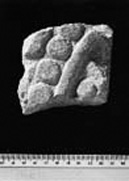
Object type: Fragment
Measurements: H. 8.5 > 7 cm (3.3 > 2.8 in); W. 9.5 > 7.5 cm (3.7 > 3 in); D. 8 > 5 cm (3.1 > 2 in)
Stone type: Pale yellowish-grey, medium-grained, shelly, oolitic limestone, including part of an echinoid test; Combe Down Oolite, Great Oolite Formation of the Bath area, Great Oolite Group, Middle Jurassic
Plate numbers in printed volume: Ills. 594-5
Corpus volume reference: Vol 4 p. 302
(There may be more views or larger images available for this item. Click on the thumbnail image to view.)
The main interlace band is about 5.6 cm wide with a central area, 2.4 cm wide, with large flat, regular pellets, 2 cm in diameter. The surface of the carving is about 1.5 cm above the background. Three bands meet on this small piece, but the pattern continued to the right on to another ashlar. Coarse, pale, brown-pink mortar with tile and chalk inclusions adheres especially to the lower broken surface but also occurs sporadically on the other broken surface and on the carved face. On the dressed face a thin spread of this mortar, with traces of whitewash, appears towards the bottom. The stone was thus already reused before Old Minster was demolished in 1093–4. The carving is confident, the pelleting more circular and better formed than the pellets on Winchester (Old Minster) no. 59.
