Volume 4: South-East England

Select a site alphabetically from the choices shown in the box below. Alternatively, browse sculptural examples using the Forward/Back buttons.

Chapters for this volume, along with copies of original in-text images, are available here.

Current Display: Winchester (Old Minster) 85, Hampshire Forward button Back button
Overview
Present Location
Winchester City Museum, Historic Resources Centre, Hyde House, Winchester, accessions no. 2943 WS 498
Evidence for Discovery
Found in archaeological excavation north of Winchester cathedral in 1968 in rubble deriving from double-apsed building around St Swithun's tomb added to west end of Old Minster; Final Phase 42 (Provisional Phase 1248), late tenth-century
Church Dedication
Old Minster
Present Condition
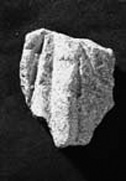
No dressed faces survive; the carved surface is battered.
Description
To the left, the drapery hangs in deeply carved folds; to the right (the front?), the folds are much less deep and the surface is subtly modelled.
Discussion
There is no other carved stone from Old Minster like this. The lively carving of the drapery is clear even on this small piece. Combinations of deep vertical and diagonal surface folds, as seen on this fragment, are characteristic of the draped figures of the mature Winchester Style, for example in the Benedictional of St Aethelwold, fol. 1v (The Choir of Virgins), fol. 4r (St Peter with two Apostles), and fol. 90v (St Aethelthryth) (reproduced in Warner and Wilson 1910; Wormald 1959). The skilled carving, the unusual use of a stone otherwise unparalleled in Old Minster (see Chap. VIII), and the probable projection of the relief, suggest a free-standing figure of exceptional quality, its scale about one-fifth life size. The stratigraphy suggests that this figure formed part of the original decoration of the double-apsed building constructed around St Swithun's tomb in the years after 971 but demolished and replaced by the westwork before 980.
Date
Late tenth century
References
Biddle and Kjølbye-Biddle forthcoming a, fig. 152, no. 86
M.B.; B.K.-B.
Endnotes

Forward button Back button
mouseover