Select a site alphabetically from the choices shown in the box below. Alternatively, browse sculptural examples using the Forward/Back buttons.
Chapters for this volume, along with copies of original in-text images, are available here.


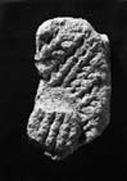
Object type: Figural(?) fragment
Measurements: H. 15 > 7.5 cm (5.9 > 3 in); W. 8.5 > 5.5 cm (3.3 > 2.2 in); D. 7 > 1.5 cm (2.7 > 0.6 in)
Stone type: Very pale brown (10YR 8/2–3), medium- to coarse-grained, shelly, oolitic limestone; Combe Down Oolite, Great Oolite Formation of the Bath area, Great Oolite Group, Middle Jurassic
Plate numbers in printed volume: Ill. 640
Corpus volume reference: Vol 4 p. 313-314
(There may be more views or larger images available for this item. Click on the thumbnail image to view.)
The dressed face forms the right side; only one face is carved.
The main carved surface is raised 2 cm from the background and has an undecorated sloping area 1 cm wide along the front right edge. At the top the background is broken away, but the carved surface ends in a smooth curve which rises vertically (as on the right) above the now missing background. Diagonally across the piece there is a pattern of raised ribs, 3–4 mm wide, joined by smaller ribs, partly in a herring-bone pattern, which gives the surface a 'knitted' texture. At the bottom left corner the relief is raised 3 cm above the background in a sub-rectangular area which rises 1 cm above the main surface and is c. 5 x 3.5 cm in area. This raised area has five ribs, each c. 8 mm wide, and each perhaps with a twist. These ribs are angled to right of vertical and thus run at an angle to the main pattern. Towards the bottom the pattern on the raised area ends in a straight line, at right angles to the direction of the ribs.
