Volume 4: South-East England
Select a site alphabetically from the choices shown in the box below. Alternatively, browse sculptural examples using the Forward/Back buttons.
Chapters for this volume, along with copies of original in-text images, are available here.
Current Display: Winchester (Old Minster) 91, Hampshire


Overview
Object type: Part of frieze
Measurements: H. 22 > 18 cm (8.7 > 7.1 in); W. 72.8 > 67.6 cm (28.7 > 26.6 in); D. 34.4 > 19.2 cm (13.5 > 7.5 in)
Stone type: Pale yellowish-grey, medium-grained, slightly shelly, oolitic limestone, including irregular pellets of 0.5 mm diameter, and 1–1.5 mm in length; Combe Down Oolite, Great Oolite Formation of the Bath area, Great Oolite Group, Middle Jurassic
Plate numbers in printed volume: Ills. 650-651, 656
Corpus volume reference: Vol 4 p. 322-323
(There may be more views or larger images available for this item. Click on the thumbnail image to view.)
Present Location
Winchester City Museum, Historic Resources Centre, Hyde House, Winchester, accessions no. 2943 WS 585
Evidence for Discovery
Found in archaeological excavation north of Winchester cathedral in 1966 reused in east wall of later medieval chapel built around tomb of St Swithun; Final Phase 74 (Provisional Phase 1511), mid thirteenth-century
Church Dedication
Old Minster
Present Condition
The stone was found almost immediately below the present surface and as a result is frost-shattered horizontally along the bedding planes (Biddle 1967a, pl. LV). The carved surface is damaged and has
Description
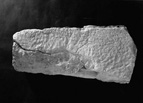
Only one face is carved.
A (broad): The left-hand section has the head, hair, and the beginning of the neck, of a beast looking right. The eye is almost round, with a tear-fold at the right edge. The hair or mane is rich, at least 23 cm wide and composed of twisted strands. A projection from the forehead, set back 1 cm from the face, may be horns or a forelock. The snout, which overhangs the lower jaw, slightly overlaps the frame. The frame has a central pattern of rectangular cuts, producing a billet-like appearance, with a plain band to the right; the left edge has broken away throughout the height of the stone. To the right of the frame there is a triangular (or, more likely, oval) bunch of berries, perhaps grapes, hanging from the innermost of a spray of at least three elements.
Discussion
The beast has a wavy mouth and a pronounced snout. The design is not unlike the relief from York, Holy Trinity Micklegate 1, which also has its snout against a frame. But the York example has more upturned snout, is much more exaggerated, has a double outline, and is of inferior design (Lang 1991, ill. 203). The York example is thought to have been part of a tympanum. The quality of the carving of the Winchester head is as good as that of the head from Monkwearmouth, co. Durham, no. 16 (Cramp 1984, ii, pl. 124 (673–6)). The scroll is like that on the cross-shaft from Heversham, Westmorland (no. 1), especially face D, which has a plant with split stem and a leftward-turning tight tendril from which hangs a single bunch of berries (Bailey and Cramp 1988, ill. 354). A spiral scroll does not exist on the Winchester piece, but could have been adjacent. The pattern on the frame is similar to Winchester (Old Minster) nos. 40 and 47 (Ills. 565–6, 576), and the head is like the bird, Winchester (Old Minster) no. 74 (Ill. 617). The present stone has carving of very high quality, seen both in the beast head and the naturalistic plant. It may be derived from Old Minster, perhaps from the area of the western addition, but because it was re-shaped for reuse in a thirteenth-century building it could have been brought from any building in the area and could be an early piece.
Date
Tenth century or earlier
References
Biddle 1967a, pl. LVb; Biddle and Kjølbye-Biddle forthcoming a, fig. 154, no. 94
M.B.; B.K.-B.
Endnotes