Select a site alphabetically from the choices shown in the box below. Alternatively, browse sculptural examples using the Forward/Back buttons.
Chapters for this volume, along with copies of original in-text images, are available here.


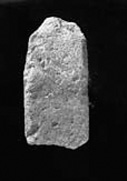
Object type: Two fragments of grave-marker
Measurements: a: H. 32.4 > 12.5 cm (12.8 > 4.9 in); W. 20.2 > 4 cm (8 > 1.6 in); D. 16.4 > 3.8 cm (6.5 > 1.5 in) b: H. 19 > 18 cm (7.5 > 7.1 in); W. 21 > 11 cm (8.3 > 4.3 in); D. 10.5 > 8 cm (4.1 > 3.1 in)
Stone type: Pale yellowish-grey, medium-grained, shelly, oolitic limestone, with calcite veinlets; Combe Down Oolite, Great Oolite Formation of the Bath area, Great Oolite Group, Middle Jurassic
Plate numbers in printed volume: Fig. 43; Ills. 713-716
Corpus volume reference: Vol 4 p. 338-339
(There may be more views or larger images available for this item. Click on the thumbnail image to view.)
Only one face is carved. A hole, 3 cm in diameter, in the lower sunken field passes horizontally through fragment a, and another hole, c. 3.5 cm in diameter, likewise passes through fragment b.
A (broad): Fragment a is part of the left side of a round-topped grave-marker and fragment b part of its right side. The face is decorated with an expanding armed cross achieved by cutting away the space between the arms to a depth of 1.2 cm and chamfering the edges thus formed. The front and back edges of the stone are finished with a similar chamfer. The cross-arms end before the edge of the stone.
Appendix A item (stones dating from Saxo-Norman overlap period or of uncertain date).
The design and carving are accomplished. Fragments a and b are almost certainly part of the same stone; Winchester (Old Minster) no. 93, even though very similar and found near-by (and given on discovery the same WS number with a letter suffix), cannot be from the same stone. This is not quite a plate-type cross-head, because the cross-arms do not reach to the edges. They are nearest to type E8, but the sides of the arms are elegantly curved, the angles between them are wider, and the junction between the arms has evidently been extended into a lozenge. In heraldic terms this is a cross formy quadrate couped (i.e. cut off before the edge of the shield) and is a sophisticated and elegant design. Comparison with Winchester (Old Minster) no. 93, where a lower part of a very similar design is preserved, suggests the possibility that the cross on the present stone originally stood on a rising feature (a hill?) indicated by the upwards curving edge of the slightly recessed area of the lower face. Since, however, this lower rising field is recessed rather than proud, it may have been cut to receive the end of a grave-cover of corresponding section, much in the way that Winchester (Old Minster) no. 2 was recessed to take the foot of no. 6 (Ill. 498). If this is so, the cross of the present piece would have appeared (when the cover and foot-stone were correctly positioned) to stand on the 'hill' represented by the ridge of the grave-cover.
A much less successful attempt at a similar effect can be seen in a grave-marker from Whithorn, Wigtownshire (Bailey and Cramp 1988, ills. 688–91), or (with a rounder head) on the crosses from Chollerton, Northumberland. These have a narrow shaft and are dated by Cramp to the Saxo-Norman overlap period, perhaps to the later eleventh century (Cramp 1984, i, 239, ii, pl. 236). A similar date for the present fragments is quite likely. The cemetery west of Old Minster, whence these stones are most likely to have come, continued in use until Old Minster was demolished in 1093–4. It was in this area that chalk cist graves were found, the only ones belonging to the Old Minster cemetery, but the type was to become common in the medieval Paradise cemetery.
