Select a site alphabetically from the choices shown in the box below. Alternatively, browse sculptural examples using the Forward/Back buttons.
Chapters for this volume, along with copies of original in-text images, are available here.


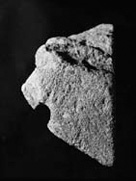
Object type: Fragment of grave-marker
Measurements: H. 20 > 10 cm (7.9 > 3.9 in); W. 13.2 > 6 cm (5.2 > 2.4 in); D. 16.9 > 15 cm (6.7 > 5.9 in)
Stone type: Combe Down Oolite, Great Oolite Formation of the Bath area, Great Oolite Group, Middle Jurassic
Plate numbers in printed volume: Ills. 710-712
Corpus volume reference: Vol 4 p. 337-338
(There may be more views or larger images available for this item. Click on the thumbnail image to view.)
This is part of the left-hand side of what was probably a round-topped grave-marker, decorated on one side only with an expanding-arm cross. Two holes have been drilled horizontally through the stone from the front to the back: the smaller, 2.6 cm in diameter, at the lower corner of the sunken field at the bottom of the cross; the larger, 3 cm in diameter, below it and a little to the left, in the lower field.
A (broad): The design, which can only be understood by reference to Winchester (Old Minster) no. 94, was achieved by recessing the field between the arms to a depth of 1.8 cm, and chamfering the edges of the cross thus formed. The edges of face A (and to a lesser degree those of face C) were also chamfered, but on A they end in an elegant curved stop 5 cm above the point at which the stone breaks off. At this point the edge of the stone appears to be curving outwards. The lower part of the stone is slightly cut back behind the main plane of the face (which would be part of the cross) on a gently curved line which rises to the foot of the cross.
Appendix A item (stones dating from Saxo-Norman overlap period or of uncertain date).
The design and carving are accomplished. Although found near Winchester (Old Minster) no. 94, and given the same WS number (with a different letter suffix) on discovery, this piece cannot be from the same stone. For discussion and references, see no. 94.
