Select a site alphabetically from the choices shown in the box below. Alternatively, browse sculptural examples using the Forward/Back buttons.
Chapters for this volume, along with copies of original in-text images, are available here.


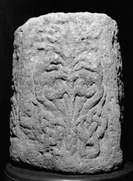
Object type: Part of cross-shaft
Measurements: H. 69 cm (27.2 in); Diameter 50 > 44 cm (19.7 > 17.3 in) Circumference 173 cm (68 in)
Stone type: Pale grey (speckled dark green), fine-grained (0.2-mm quartz grains), glauconitic sandstone, with possibly cherty cement; Upper Greensand, Gault group, Lower Cretaceous; Hampshire or Wiltshire
Plate numbers in printed volume: Ills. 686-690
Corpus volume reference: Vol 4 p. 333-334
(There may be more views or larger images available for this item. Click on the thumbnail image to view.)
The shaft is of circular section and tapers towards the upper end where it is broken roughly horizontally. The underside is dressed flat. Around the lower edge is a broad, plain raised border, and the circumference is divided into four equal fields by similar vertical borders on stepped bases.
A: This field contains a bush scroll. The thick half-round stem develops from the lower frame. From each side of the stem emerges one of a pair of thick, out-turned subsidiary stems, each of which develops into tight interlace filling the interstices between the main stem and the edge of the field. Above them is a pair of upward-leaning, expanding stems, each terminating in an inward-facing animal head touching the main stem, and curling round one of a pair of thick, down-turned stems developing from the main stem just above the scrolls. From the upper part of the stem develop six closely-spaced pairs of narrow, outward-curving leaves.
B: This field is decorated with a naturalistically-modelled stag facing left, with its hindquarters against the right-hand frame. It is heavily damaged but has a long neck, and antlers developing into disorganised interlace filling the interstices between the animal and the border.
C: This area is decorated with a bush- or tree-scroll, now largely destroyed. It has a vertical stem with two subsidiary stems curling back, one on each side of the main stem. Each is brought round to touch the main stem before terminating in a berry bunch, and acanthus leaves filling the space between the main stem and the border.
D: This field is decorated with interlace, now largely destroyed.
