Select a site alphabetically from the choices shown in the box below. Alternatively, browse sculptural examples using the Forward/Back buttons.
Chapters for this volume, along with copies of original in-text images, are available here.


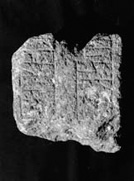
Object type: Grave-cover
Measurements: L. 19 cm (7.5 in); W. 18 cm (7.1 in); D. 12 cm (4.7 in)
Stone type: Grey (with a greenish tinge), shell-fragment limestone; Quarr stone, Bembridge Formation, Palaeogene, Tertiary; Isle of Wight
Plate numbers in printed volume: Fig. 42; Ills. 667-670
Corpus volume reference: Vol 4 p. 327-328
(There may be more views or larger images available for this item. Click on the thumbnail image to view.)
It is sub-rectangular and roughly broken at either end and below. The long edges to the left and right are dressed flat, and only slightly damaged.
A (top): Inscription The face of the stone contains the remains of an inscription in Scandinavian runes. Standing opposite each other are two fragmentary sequences of runic characters, (a) and (b), placed between framing lines that parallel the edges of the stone. The bases of the runes point inwards, which suggests that the inscription ran up one edge of the face and down the other. Although the runes and dividers are damaged in a number of places, they are not significantly worn and several look quite fresh. In addition, there are clear traces of red paint here and there in the framing lines and in most of the characters. Apparently the stone was not exposed to wind and weather for very long.
Since the layout of the inscription provides no guidance about which way up the stone stood, it is difficult to know whether text (a) or text (b) should be read first (see, however, the discussion below).
(a) --(R)[:]auk[o]l[: .]--
(b) --[.](u)sk[. .]--
The monument can be reconstructed as of square section with a convex upper face which carries the inscription (see Fig. 42). While the form of the monument is uninformative in terms of dating, it is likely that the inscription is in Old Norse, which would point to the period of Scandinavian political dominance in Winchester for its making, probably in the period 1016 - 42 (see below).
Inscription Given the fragmentary nature of the inscription, it is impossible to produce a text. The few runes that survive are susceptible to differing interpretations. If it is assumed that the carver placed his or her dividers at word boundaries, (a) is most likely to contain a personal name (Old Norse Auðkell). Dividers were, however, sometimes placed within words, and often used only sporadically. This makes it possible to suggest that (a) preserves a sliver of text from the beginning of a typical memorial inscription, in which the names of those who commissioned the inscription are recorded. --(R) might then be the nominative singular termination of a name (probably male) and the following three characters could denote auk ('and') and the remainder of the fragment the beginning of a further name (perhaps Óláfr). It is harder to select a linguistic context for fragment (b). A rounded vowel plus /sk/ is a common sequence in verbal endings and adjectival roots, as well as in other parts of speech. It may even be that more than one word is involved here, or perhaps two elements of a compound. If the latter is supposed, the word húskarl ('retainer', 'member of the king's bodyguard') becomes a distinct possibility.
Rune forms (or, more precisely, the likely rune-phoneme correspondences * /a/, */s/, and possibly * /R/) and layout combine to suggest a tenth- or eleventh-century, Danish-inspired inscription. That a Dane would have raised a memorial stone in tenth-century Winchester seems improbable, and the likelihood must rather be that it dates from the time of Cnut or thereabouts, when it would not be unexpected to find Scandinavian húskarlar in this centre of royal and ecclesiastical power (cf. Winchester (Old Minster) no. 6).
