Select a site alphabetically from the choices shown in the box below. Alternatively, browse sculptural examples using the Forward/Back buttons.
Chapters for this volume, along with copies of original in-text images, are available here.


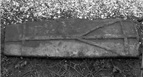
Object type: Grave-cover [1]
Measurements: L. 182 cm (71.7 in); W. 55 cm (21.7 in); D. 17 cm (6.7 in)
Stone type: Greenish-grey, medium-grained (3-mm quartz grains), glauconitic sandstone; Hythe Beds, Lower Greensand Group, Lower Cretaceous; Petersfield to Pulborough area
Plate numbers in printed volume: Ill. 220
Corpus volume reference: Vol 4 p. 188
(There may be more views or larger images available for this item. Click on the thumbnail image to view.)
Tapering cover with a square head and foot.
A (top): There is a narrow, relief, median moulding crossed close to each end by a moulding spanning the width of the stone. At the head end a pair of narrow, oblique, relief mouldings link the ends of the cross piece with the median moulding, about half-way along its length. The opposing ends are carried around the head to form a border.
Appendix A item (stones dating from Saxo-Norman overlap period or of uncertain date).
The church at Chithurst is a substantially intact eleventh-century structure. It therefore seems very unlikely that the covers could have been recovered during later rebuilding, as they were at near-by Stedham. Instead, it is probable that the covers have been discovered piecemeal during grave digging, and have gradually accumulated along the north wall of the church. That the recovery of the grave-covers has taken place over a relatively long period is suggested by the fact that some, particularly those alongside the church, are only slightly sunk into the modern ground surface. Others, particularly to the north west of the church have been overwhelmed by the gradual accumulation of spoil from grave digging, and are buried up to 10 cm below the modern ground surface. Only the edges, alongside the path to the church are visible.
The covers at Chithurst seem to represent a very highly localised group; only no. 1 overlaps in its decoration with covers from the near-by group of material at Stedham (e.g. no. 4; Ill. 241). Similarly, the median ridge type with crossed ends, which predominates at Chithurst, is not found at Stedham.
