Select a site alphabetically from the choices shown in the box below. Alternatively, browse sculptural examples using the Forward/Back buttons.
Chapters for this volume, along with copies of original in-text images, are available here.


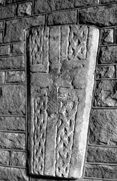
Object type: Grave-cover
Measurements: H. 89 cm (35 in) (W. 50 cm (19.7 in); D. Built in
Stone type: Yellowish-grey, medium-grained, shelly, oolitic limestone; Barnack stone, Lincolnshire Limestone Formation, Inferior Oolite Group, Middle Jurassic
Plate numbers in printed volume: Ill. 264
Corpus volume reference: Vol 4 p. 207
(There may be more views or larger images available for this item. Click on the thumbnail image to view.)
Part of a tapering grave-cover which is incomplete above and below, where it has been roughly horizontally trimmed.
A (top): The slightly convex face is decorated with a low-relief Latin cross (type A1). The expanding lateral arms terminate on the edges of the stone. Below each lateral arm, and separated from it by an incised line, is a broad, plain, low-relief border. Its inner end terminates on the lower limb of the cross and is separated from it by an incised line. The outer end unites with a broad, plain lateral border. Each of the fields thus defined is decorated with a four-strand plain plait. The decoration above the lateral limbs is similar except that each of the decorative fields has an inner broad, plain, low-relief border flanking the head of the cross, and separated from it by an incised line. The interlace in the upper fields is median-incised.
Both in terms of material and in the layout and handling of the decoration, this forms one the East Anglian group of grave-covers, first recognised by Fox (1920–1). It belongs with his group B, those with incised crosses, and within that group to his type 4. If so, then the mid-rib would have originally terminated in a cross with expanding arms at either end, as at Rampton, Cambridge castle, and Little Shelford, all in Cambridgeshire (ibid., pl. IV).
A terminus ante quem for this group of covers is provided by the discovery of examples sealed by the rampart of Cambridge castle, constructed in 1068 (ibid., 20–1, appendix). Two similar examples were discovered in situ outside the pre-Conquest church under Peterborough cathedral, which has been assigned to the refoundation of the monastery under Aethelwold in 970 (ibid., 23–4, 31–2).
