Select a site alphabetically from the choices shown in the box below. Alternatively, browse sculptural examples using the Forward/Back buttons.
Chapters for this volume, along with copies of original in-text images, are available here.


Object type: Grave-cover
Measurements: L. 75 cm (29.5 in); W. 62 cm (24.4 in); D. Built in
Stone type: Greyish (thinly whitewashed), medium-grained (0.3-mm quartz grains), glauconitic sandstone; Hythe Beds, Lower Greensand Group, Lower Cretaceous; Petersfield to Pulborough area
Plate numbers in printed volume: Ill. 228
Corpus volume reference: Vol 4 p. 190-191
(There may be more views or larger images available for this item. Click on the thumbnail image to view.)
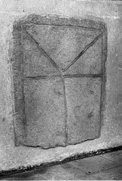
Incomplete tapering grave-cover terminating below in a roughly horizontal break. The lower half is lost.
A (top): An incised median line bifurcates well short of the head end, the bifurcations being carried into the upper corners where they unite with an incised line delimiting the broad plain border. Immediately below the bifurcation the median line is crossed by an incised line whose ends touch the inner edge of the border.
Appendix A item (stones dating from Saxo-Norman overlap period or of uncertain date).
Cocking, like Chithurst, was a small two-celled eleventh-century Sussex church, dated by Johnston to c. 1080 (Johnston 1921, 182). In 1896 the chancel was greatly enlarged, and the stone recovered from the foundations of the north wall of the eleventh-century chancel. Taken with the evidence from Stedham, Sussex, which has produced similar covers, this suggests that monuments of this type were in use in the mid to late eleventh century, although it is impossible to be sure if the series began before the Conquest.
This cover has decoration of the same pattern as one of the examples from Stedham (no. 4; Ill. 241), but incised and not in relief.
