Volume 4: South-East England
Select a site alphabetically from the choices shown in the box below. Alternatively, browse sculptural examples using the Forward/Back buttons.
Chapters for this volume, along with copies of original in-text images, are available here.
Current Display: Corhampton 01, Hampshire


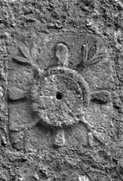
On a sub-rectangular panel is a circular dial in relief, its frame delimited by an incised line paralleling its edge. In the centre is a drilled gnomon hole. The lower part of the dial is calibrated; the lines of calibration are incised. There is a pair of horizontals, a vertical, and a line mid-way between each horizontal and the vertical. The vertical and the lines to the right are crossed close to their ends, the ends of the cross-bar and principal lines being drilled. To the left, only the horizontal with its drilled end, and the inner end of the intermediate line survive. Above and below, and to each side of the dial are bulbous protrusions in relief, narrowing towards the dial. Between each pair a narrow relief stem develops from the dial and runs into the corner of the slab where it terminates in three long, narrow, convex-sided, hollowed leaves.
The near-by dial from Warnford (no. 1; Ill. 478) and that from Winchester (St Michael, no. 1; Ill. 671), together with the present example, form a clear group. All use a circular dial on a square stone. They all share the same calibration, with the lower half of the dial only calibrated, the mid-tide lines crossed near their ends, and the use of drilled holes to end some of the lines, although there are minor variations between dials. They all have foliate ornament filling the corners. At Winchester and Warnford this ornament consists of conventionalized fleur-de-lys trefoil leaves. On no. 1 the leaf sprays are more realistic, consisting of three leaves on a longer stalk. The bulbous features between the leaf sprays, and forming a cross, are unique to the present stone. They appear to be derived from the Ringerike style, which employs just such a motif, as on a grave-cover from London (City 1; Ill. 353). If so, then this motif helps to fix the date of the present dial in the first half of the eleventh century.
Haigh 1846, 408, 414, fig. on 408; Hussey 1852, 199; Haigh 1857, 177 - 8, fig. on 178; Way 1868, 211; Haigh 1879, 135, 155 - 6, fig. on 156; Slessor 1888, 7 - 8; Allen 1889, 201; Gatty 1889, 424; Syers 1899, 18; Brown 1900b, 337; Doubleday and Page 1903, 240 - 1; Nisbett 1905 - 7, 37; Johnston 1907, 17; Page 1908a, 252; Jessep 1913, 17, fig. 5; Green 1926, 19 - 20, pl. V; Green 1928, 498 - 9; Cottrill 1931, appendix; Clapham 1935b, 415; Cole 1939, 148; Zinner 1939, 8, taf. 20, abb. 33; Green 1943, 269, 273; Cox and Jowitt 1949, 22, 71, 178; Green and Green 1951, 57, pl. XIX; Crowley 1956, 176; Fisher 1959, 95; Taylor 1962a, 169; Zinner 1964, iv, 65 - 6, 210, 216, abb. 7; Taylor and Taylor 1965 - 78, i, 178; Radford 1966a, 189; Taylor and Taylor 1966, 19 - 20, fig. 8; Bowen and Page 1967, 288; Pevsner and Lloyd 1967, 182; Tweddle 1986b, i, 84, 166, 170, 187 - 8, ii, 374 - 5, iii, pl. 38b
D.T.