Select a site alphabetically from the choices shown in the box below. Alternatively, browse sculptural examples using the Forward/Back buttons.
Chapters for this volume, along with copies of original in-text images, are available here.


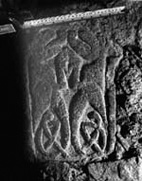
Object type: Part of cross-shaft [1]
Measurements: H. 38 cm (15 in) (W. 28 (11 in); D. 15 cm (5.9 in)
Stone type: Light grey, medium-grained, shelly, oolitic limestone; Barnack stone, Lincolnshire Limestone Formation, Inferior Oolite Group, Middle Jurassic
Plate numbers in printed volume: Ills. 265-267
Corpus volume reference: Vol 4 p. 206-207
(There may be more views or larger images available for this item. Click on the thumbnail image to view.)
It is of rectangular section and roughly broken above, below, and to the rear.
A (broad): Along the left and right-hand edges is a plain, raised border. The face is decorated with a pair of heavily-weathered, confronted, winged bipeds. The mouth of each animal is open, and the upturned ends of the tongues touch. Each animal has a short, backward-pointing ear overlapping the border. The bodies taper and curve inwards to touch on the vertical axis of the face before curving outwards once more and developing into angular interlace. A loose strand of interlace with a clubbed end turns up to touch the tip of the downward-pointing kite-shaped wing of each animal. Each animal has an upturned leg, terminating in a triangular, three-toed foot, with incised nicks indicating the toes. The feet touch on the vertical axis of the face.
B (narrow) and C (broad): Built in.
D (narrow): Has a plain raised border along its left-hand edge, but the right hand edge is roughly broken. The face is decorated with a four-cord interlace, simple pattern F.
The confronted animals on face A most closely resemble those on the shaft from Elstow (Ill. 269), two miles south of Bedford. The present stone is, however, part of a much smaller and slighter monument.
The use of winged bipeds in the decoration points to an eighth- or early ninth-century date for the piece, and this is supported by the fact that the animals actually develop into interlace, a trick first introduced into Anglo-Saxon art in the middle of the eighth century (Chap. V).
