Select a site alphabetically from the choices shown in the box below. Alternatively, browse sculptural examples using the Forward/Back buttons.
Chapters for this volume, along with copies of original in-text images, are available here.


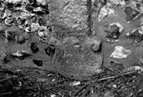
Object type: Pilaster base
Measurements: H. 20 cm (8 in); W. 24 cm (9.5 in); D. 5.5 cm (2.2 in)
Stone type: Grey (with a greenish tinge and a variable yellow or red-brown lichen coating) limestone, composed of close-packed shell-fragment moulds; Quarr stone, Bembridge Formation, Palaeogene, Tertiary; Isle of Wight
Plate numbers in printed volume: Ill. 440
Corpus volume reference: Vol 4 p. 257
(There may be more views or larger images available for this item. Click on the thumbnail image to view.)
Apart from the bases catalogued below (Corhampton nos. 3, 4c–d), three others may have had similar decoration. The south-east pilaster of the nave has been largely cut away, and the north-east pilaster of the chancel is masked by a Victorian vestry. No trace of decoration survives on the base of the median pilaster on the west wall. The incorrect reconstruction proposed by Taylor and Taylor for the pilaster bases from this site is apparently based on the south-east pilaster of the chancel, which is heavily weathered. The present well-preserved base is concealed by a grave-stone and escaped their notice.
As with the other sculptures from this site, the dating evidence depends closely on the architectural dating of the fabric. Taylor and Taylor suggested a date in the second half of the eleventh century (Taylor and Taylor 1965–78, i, 177), though, if the date suggested above for the sundial is correct, a date rather earlier in the eleventh century is possible.
