Select a site alphabetically from the choices shown in the box below. Alternatively, browse sculptural examples using the Forward/Back buttons.
Chapters for this volume, along with copies of original in-text images, are available here.


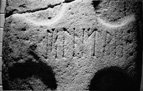
Object type: Grave-cover, in two joining pieces [1]
Measurements: L. 184 cm (72.4 in); W. 67 cm (26.4 in); D. 18 cm (7 in)
Stone type: Dark greenish-grey, glauconitic, sandy limestone, bioturbated and with an 80 mm-diameter Nautiloid cast on the rear surface; Kentish Ragstone, Hythe Beds, Lower Greensand Group, Lower Cretaceous; from the Sellindge to Hythe outcrop
Plate numbers in printed volume: Ills. 76-77
Corpus volume reference: Vol 4 p. 143-144
(There may be more views or larger images available for this item. Click on the thumbnail image to view.)
Tapering cover with a semicircular head and foot. It is broken into two unequal parts, the break rising from left to right just below the horizontal arms of the low relief Latin cross decorating the convex top.
A (top): The head of the cross (lateral arms type B10, upper arm type E9) is close to and parallels the edge of the stone, and the sides of the arms are concave, the curves being continuous with those of the upper edges of the square-ended horizontal arms. The curves of the concavities of the lower edges of these arms return slightly before the edges of the broad lower limb of the cross are carried down the stone in parallel. The limb is splayed close to the foot. Its end is convex and parallels the foot of the stone. Across the horizontal arms of the cross is incised a runic text.
Inscription The inscription, in Anglo-Saxon runes, is set along the arms of the cross, upside-down with respect to its head. Lines are punched out, and most of the terminals bear wedge-shaped serifs. The first rune is worn and partly broken away, but enough remains for identification to be certain. The earliest published drawing suggests it may have been clear and undamaged when the stone was found ((— ) 1834, 604). The three wedge-shaped points which follow the runes are deeply cut and clearly intentional. The inscription reads:
+(j)ȝslheard*
This is a form of the attested Old English masculine personal name Gislheard.2
This stone is not closely paralleled in its regional context. The form of the cross suggests a date in the tenth or eleventh centuries.
D.T.
Inscription Two choices made by the rune-master are noteworthy. The representation of palatal g by 'j' finds a parallel in England on an inscribed stone from Thornhill, Yorkshire (Page 1973, 145). There is, however, insufficient evidence to determine whether the use, in both cases, of this particular form of 'j' reflects an epigraphical tradition at variance with the runic lore recorded in manuscripts, as Page has argued (Page 1973, 46). The choice of 'Ȝ' where 'i' seems equally possible is a potentially early feature, for the rune may originally have denoted a high front vowel, eventually falling together with the sounds given by 'i'. Its use elsewhere for a velar consonant seems to be a later stage of development, derived from the final sound of the rune-name ih; however, at any period the general principle of choosing a rune by the initial sound of its name might have suggested 'Ȝ' as a straight alternative to 'i'. Elliott dates the inscription to the ninth or early tenth century on the grounds that 'there are no early features either in the runes or in the name itself' (Elliott 1989, 108–9), but this is unfounded. There are simply no linguistic or runic features which exclude any date after the conversion of the Anglo-Saxons to Christianity.
D.P.
