Volume 4: South-East England
Select a site alphabetically from the choices shown in the box below. Alternatively, browse sculptural examples using the Forward/Back buttons.
Chapters for this volume, along with copies of original in-text images, are available here.
Current Display: Dover (St Mary In Castro) 01, Kent 

Overview
Object type: Grave-cover
Measurements: L. 110 cm (43.3 in); W. 37 > 27 cm (14.6 > 10.6 in); D. 10 cm (3.9 in)
Stone type: Pale yellow, fine-grained limestone; Caen stone, Calcaire de Caen Formation, Bathonian, Middle Jurassic; from Caen, Normandy
Plate numbers in printed volume: Ills. 62-63, 68
Corpus volume reference: Vol 4 p. 139-140
(There may be more views or larger images available for this item. Click on the thumbnail image to view.)
Present Location
Built into the western-most arch of the sedilia at the south-east end of the nave
Evidence for Discovery
Discovered during restoration by Scott in 1860-2, reused as paving of central opening of footing of probably late twelfth-century screen (Newman 1974, 287) spanning western tower arch (Puckle 1864, 54)
Church Dedication
St Mary in Castro
Present Condition
Broken and worn
Description
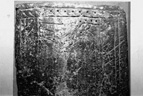
A tapering cover with a square head and foot; each of the edges is slightly convex. It is broken into three approximately equal parts, the breaks rising from right to left. The decoration is largely defaced except at the head end and in a small area to the lower left. Close to, and paralleling the head of the stone is an incised line stopping short of the edges to the left and right. Inside it is a second line paralleling the head. From the outer edge of this emerges a series of short, oblique incised lines leaning to the left with their ends pecked. The base line is returned to parallel the edges to the left and right. To the left, inside and close to this line, is a second similar incised line from the inner edge of which emerge a series of oblique lines leaning towards the head of the stone, a decorative zone bounded on its inner side by a third incised line. To the right the arrangement is similar except that the oblique lines emerge from the outer edge of the inner line. The incised decoration of the main face is heavily damaged, but appears to consist of incoherent foliate ornament. In the area of decoration surviving to the lower left two incised lines parallel the left-hand edge, and from the inner of these emerge three incised, curved, upward-leaning lines.
Discussion
After discovery, it was reburied below the new tiled floor protected by a second slab, and was probably recovered during the restoration of the church by Butterfield in 1888.
Date
Eleventh century
References
Puckle 1864, 54 - 5, fig. facing 54; Clapham 1929a, 255; Cottrill 1931, appendix; Tweddle 1986b, i, 89, 226, ii, 380 - 1, iii, pl. 42a - b
D.T.
Endnotes
