Volume 4: South-East England
Select a site alphabetically from the choices shown in the box below. Alternatively, browse sculptural examples using the Forward/Back buttons.
Chapters for this volume, along with copies of original in-text images, are available here.
Current Display: Ford 01, Kent 

Overview
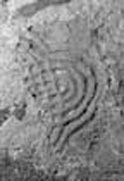
Object type: Fragment [1]
Measurements: H. 24 cm (9.5 in); W. 14.5 cm (5.7 in); D. Built in
Stone type: Pale grey, fine-grained sandstone, apparently finely glauconitic; Upper Greensand, Gault Group, Lower Cretaceous; possibly from the vicinity of Bignor, Sussex
Plate numbers in printed volume: Ill. 78
Corpus volume reference: Vol 4 p. 144
(There may be more views or larger images available for this item. Click on the thumbnail image to view.)
Present Location
Incorporated in the north face of the nave wall, into the head of the door into the vestry
Evidence for Discovery
First recorded in Johnston 1900
Church Dedication
St Andrew
Present Condition
Broken and worn
Description
The fragment is sub-rectangular and is decorated with an incomplete quatrefoil composed of two groups of four concentric ovals crossing at right angles, and interlacing where they cross.
Discussion
It has probably been in its present location since c. 1420 when the doorway into which it is incorporated was inserted into the eleventh-century nave wall. No original edge of the fragment survives, making it impossible to ascertain its original function.
Date
Tenth to eleventh century
References
Johnston 1900a, 118 - 20, fig. 5; Johnston 1905, 155; Page 1907, 364; Jessep 1914, 31 - 2; Mee 1937, 164; Nairn and Pevsner 1965, 226; Fisher 1970, 33, 113, 115; Tweddle 1986b, i, 112, 253, ii, 385, iii, pl. 45a
D.T.
Endnotes
