Select a site alphabetically from the choices shown in the box below. Alternatively, browse sculptural examples using the Forward/Back buttons.
Chapters for this volume, along with copies of original in-text images, are available here.


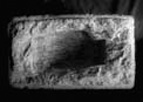
Object type: Part of cross-shaft
Measurements: H. 56 cm (22 in) (W. 32 cm (12.6 in); D. 20.5 cm (8 in)
Stone type: Pale brownish-grey, medium-grained, shelly, oolitic limestone with planar bedding; Barnack stone, Lincolnshire Limestone Formation, Inferior Oolite Group, Middle Jurassic
Plate numbers in printed volume: Ills. 268-272
Corpus volume reference: Vol 4 p. 208-209
(There may be more views or larger images available for this item. Click on the thumbnail image to view.)
It is of rectangular section. The upper end is stepped and roughly broken, and the lower end is dressed flat.
A (broad): Has a narrow, plain, raised border containing a pair of confronted winged bipeds developing into interlace. The muzzle of the animal to the left is square ended. The open mouth is contoured by an incised line, and the long thick tongue hangs limply down. The upper canine tooth is well marked. The head is domed over the lentoid eye. The eye is defined by incised lines and has a pecked pupil. The ear is long and backward pointing with a clubbed end and incised central line. It is placed well back on the head. The expanding neck curves inwards to join the outward-curving, tapering body, which develops into well-ordered interlace, complete pattern D, filling the lower half of the face. From the junction of the neck and body develops a tapering, upward-pointing wing. Its inner edge follows the curve of the neck, and its out-turned, clubbed end interlaces with that of the ear. A short foreleg hangs limply down. The wing, neck, and body are contoured by incised lines, that of the body being extended to form median-incised interlace. The animal to the right is a mirror image of that to the left, the interlace developing from it forming part of the interlace pattern.
B (narrow): The border is like that on face A. Within is a single winged biped. The top of its head is placed against the upper left-hand border. The muzzle is rounded-ended, and the mouth, contoured by an incised line, slightly open. The head is domed over the lentoid eye which is indicated by incised lines. The pupil is pecked. The ear runs into the left-hand corner of the face. It is small, hollowed, and pointed. From the lower jaw develops a short lappet. A second lappet, terminating in a clubbed, out-turned end, develops from the back of the expanding neck which curves round the upper end of the panel and is carried across to join the tapering body. This continues the curve of the neck towards the left-hand border before curling back in a tight spiral. The downward-pointing tapering wing has a rounded base. Its tip is extended to form a diagonal interlacing with the spiral. The loose ends of the spiral and wing develop into well-ordered interlace, an element of spiralled pattern A and, below, an element of pattern C with bar-terminal. The short foreleg of the animal is bent upwards against the left-hand border. A pair of short incised lines indicate the toes. The neck, body, and wing are contoured with incised lines. Those of the body and wing are extended to form median-incised interlace strands.
C (broad): The border is like that on face A and contains a register of complete pattern C, the upper terminal cross-joined and the lower alternate-joined, composed of thick strands in high relief.
D (narrow): The border is like that on face A. Within is a pair of outward-facing, inward-looking winged bipeds. The head of the upper animal is placed against the upper left-hand border and resembles that of the animal on face B except that the ear has a incised central line, is long, and has a clubbed end. The animal's foreleg is bent upwards and placed against the upper border. A pair of short incised lines indicate the toes. The narrow tapering body curves to the left beneath the muzzle before curving back. The tail interlocks with that of the second animal to form a spiral and terminates in a barbed tip placed against the underside of the second, lower animal. This resembles the first except that its head is against the lower right-hand border. An incised line contours the body of each of the animals, in each case being extended to form the median-incised line of the tail. The thick tongues of the two animals are linked across and interlace with the spiral formed by the tails, and have median-incised lines.
The fragment had been reused as building material in the blocking of the eastern end of the nave, once the conventual part of the church had been demolished. This demolition took place in 1539 (Baker 1969, 30–1).
This piece represents part of one element of a square cross-shaft originally constructed in sections. The trimming of the upper end has shortened the fragment, but a slight stepping in of the faces can still be detected, suggesting the piece originally came from a stepped shaft. Even though the upper end has been trimmed, remains of a rectangular socket survive, presumably intended to receive a tenon on the lower end of the next element of the shaft.
The dating of this piece is determined by the use of winged bipeds, an eighth- and early ninth-century phenomenon, and by the fact that the bipeds on faces A and B develop into interlace. This trick was introduced into Anglo-Saxon art in the mid eighth century. The decoration on face A is closely comparable to that on face A of Bedford 1 (Ill. 265).
