Select a site alphabetically from the choices shown in the box below. Alternatively, browse sculptural examples using the Forward/Back buttons.
Chapters for this volume, along with copies of original in-text images, are available here.


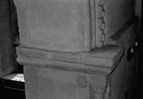
Object type: Part of grave-cover or sarcophagus [1]
Measurements: L. 94 cm (37 in) (W. 36 cm (14.2 in); D. 12.5 cm (4.9 in)
Stone type: Light grey, fine- to medium-grained (0.2 to 0.3-mm quartz grains), glauconitic sandstone, cross-bedded and with burrows of 8 to 9-mm diameter; possibly Thanet Beds, Palaeogene, Tertiary; from Reculver, Kent
Plate numbers in printed volume: Fig. 32; Ill. 263
Corpus volume reference: Vol 4 p. 209-210
(There may be more views or larger images available for this item. Click on the thumbnail image to view.)
The south jamb of the chancel arch is of fundamentally square section, with an engaged western angle shaft, and supports an abacus of square section, its lower edge chamfered. This, in turn, supports an impost, also of square section. The arch is substantially narrower than the jamb, and its full width is supported by a grave-cover reused face upwards, which forms the bulk of the impost. Only the boldly projecting west end of the impost, supported by the angle shaft, is composed of a separate stone. The grave-cover is roughly broken, both where it abuts this stone and to the rear. The front and left-hand edges are dressed flat.
A (top): The upper face is partially concealed by the soffit of the chancel arch which is recessed only 12 cm behind the front edge, leaving a narrow band of decoration exposed. It is decorated in the Ringerike style. From the mid-point of the soffit edge emerges a pair of diverging, tapering foliate tendrils. That leaning to the left terminates close to the left-hand edge against a second similar tendril emerging from the soffit edge; that leaning to the right is shorter and terminates close to a similar tendril emerging from the soffit edge. To the right of this is a tight interlace knot. A broad, irregular curved band is superimposed on this pair of tendrils, and a series of minor tendrils interlace with it.
The piece was probably broken up for building material when the present chancel was constructed in the first half of the twelfth century. The sheer size of the surviving fragment, nearly a metre wide and 35 cm thick, is suggestive. It is both wider and much thicker than London (St Paul's) 1, which is interpreted as a grave-marker. It is very thick even for a grave-cover, where the normal thickness is of the order of 11–12 cm. Of course, it is perfectly possible that it is merely a very large example of a well-known type, and that it is a fragment of a grave-marker. Alternatively, it could be the side panel of a box tomb or sarcophagus. The Ardre tomb, for example, has side panels 83 cm wide. No other box tomb is, however, known from England.
Although only part of the decorated face survives, and only a part of that is visible, there is little doubt that the decoration is in the Ringerike style. The use of this style, together with the very flat style of carving, links the carving with pieces from London (St Paul's 1, City 1, and All Hallows 1), and Rochester 2 and 3, Kent.
