Select a site alphabetically from the choices shown in the box below. Alternatively, browse sculptural examples using the Forward/Back buttons.
Chapters for this volume, along with copies of original in-text images, are available here.


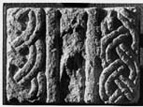
Object type: Fragment of grave-cover
Measurements: H. 28 cm (11 in) (W. 39 cm (15.4 in); D. 11.5 cm (4.5 in)
Stone type: Yellowish-grey, medium-grained, oolitic limestone, with scattered 5–10 mm shell fragments; Barnack stone, Lincolnshire Limestone Formation, Inferior Oolite Group, Middle Jurassic
Plate numbers in printed volume: Ills. 273-276
Corpus volume reference: Vol 4 p. 210-211
(There may be more views or larger images available for this item. Click on the thumbnail image to view.)
It is cut down to form a regular rectangular block, with the edges and back dressed flat.
A (top): A broad median moulding, partly cut back, is flanked by a pair of narrower plain relief mouldings. These are, in turn, flanked by zones of interlace decoration. The interlace, in high relief, is in each case a three-strand plain plait with median-incised strands. The outer edge of each zone has been partially destroyed by the shaping of the block.
B and D (sides): On the vertical axis of the left and right-hand sides are narrow, rectangular slots, each tapering a little towards the flat base.
The slots on the edges appear to be carrying handles, cut at about the time of the removal of the piece to the church.
The arrangement of the decoration suggests that this is part of a grave-cover of the East Anglian type first defined by Fox (1920–1). These employ a median ridge, crosses in the middle and towards each end (or, alternatively, with the ends developing either into U- or V-shapes or small crosses). The median ridge is flanked by panels of interlace. This fragment probably comes from near the foot of such a cover, as the interlace is a three-strand plain plait. The fields further towards the head end were usually decorated with four-strand plaits, one strand being lost towards the foot as the panels there were narrower to accommodate the taper.
There is archaeological evidence for a late Anglo-Saxon date for this group (see Cardington 1).
