Select a site alphabetically from the choices shown in the box below. Alternatively, browse sculptural examples using the Forward/Back buttons.
Chapters for this volume, along with copies of original in-text images, are available here.


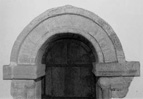
Object type: Doorway with decorated capitals (a-b), imposts (c-d), and hood mould (e)[1]
Measurements:
Capital (a, east): H. 20 cm (7.9 in) (W. 17 cm (6.7 in); D. 19 cm (7.5 in)
Capital (b, west): H. 24 cm (9.5 in) (W. 20 cm (7.9 in); D. 19 cm (7.5 in)
Impost (c, east): H. 26 cm (10.2 in) (W. 62 cm (24.4 in); D. 75 cm (29.5 in)
Impost (d, west): H. 26 cm (10.2 in) (W. 82 cm (32.3 in); D. 74 cm (29 in)
Stone type: Pale yellowish-grey, medium- to coarse-grained, shelly, oolitic limestone, bedding generally planar; Barnack stone, Lincolnshire Limestone Formation, Inferior Oolite Group, Middle Jurassic
Plate numbers in printed volume: Ills. 277-284
Corpus volume reference: Vol 4 p. 211-212
(There may be more views or larger images available for this item. Click on the thumbnail image to view.)
Rodwell has argued that the north doorway of the nave is a medieval reconstruction, either in its original location or moved here from elsewhere in the building (Rodwell 1976, 64). Clearly much more has been lost from the original building, including the north porticus arch and the chancel arch, both probably decorated in the same manner as the surviving north doorway and south porticus arch. In addition a sketch by William Cole reveals that a second doorway, similar to the north door of the nave, survived as late as 1746 in the north wall of the medieval chancel. Like the surviving doorway, it was probably decorated.
The use of early Romanesque architectural features, in particular angle shafts and soffit rolls, in this building serve to place it in the middle of the eleventh century, either just before or just after the Norman Conquest. Similarly the parallels for the plant ornament lie on either side of the Conquest. For example, there is very similar leaf ornament on fol. 171 of the Winchcombe Psalter, a work of c. 1030–50 (Temple 1976, no. 80, ill. 253) and on the mid twelfth-century east impost of the south doorway at Great Canfield, Essex.
