Volume 4: South-East England
Select a site alphabetically from the choices shown in the box below. Alternatively, browse sculptural examples using the Forward/Back buttons.
Chapters for this volume, along with copies of original in-text images, are available here.
Current Display: Hannington 01, Hampshire 

Overview
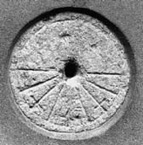
Object type: Sundial
Measurements: Diameter 38.5 cm (15 in); D. Built in
Stone type: Pale yellowish-grey (10YR 8/1–2), medium-grained, shelly oolitic limestone with numerous polyzoa fragments; Bath stone, possibly Ancliff Oolite, Great Oolite Formation, Great Oolite Group; Middle Jurassic; Bradford on Avon
Plate numbers in printed volume: Ill. 441
Corpus volume reference: Vol 4 p. 258-259
(There may be more views or larger images available for this item. Click on the thumbnail image to view.)
Present Location
Built into south wall of nave, outside, east of blocked doorway
Evidence for Discovery
First noticed by M. J. Hare in early 1970s; presumably exposed during plaster stripping, as not mentioned in Taylor and Taylor 1965-78
Church Dedication
All Saints
Present Condition
Intact, somewhat bruised, and moderately heavily weathered
Description
The stone is circular with a plain outer frame delimited by an incised line. There is a central circular gnomon hole, irregularly splayed towards the front. The calibration, in incised lines, consists of the mid tide lines at 6 am and 6 pm extending roughly horizontally to touch the edge of the stone. The mid tide lines at 9 am, noon, and 3 pm, touch the inner edge of the frame, and are crossed short of their ends. The ends of the line and the cross-arm terminate in drilled holes. The intervening lines, at 7.30 am, 10.30 am, 1.30 pm, and 4.30 pm, marking the beginnings and ends of the tides, terminate on the inner edge of the frame; they are not crossed.
Discussion
The calibration of the dial is done in the standard pre-Conquest fashion, employed also at Corhampton, Warnford, and Winchester (St Michael) 1 in Hampshire. The dial itself, however, is circular, as opposed to circular on a rectangular frame as with the other Hampshire dials. The close comparison between these dials, at least in calibration, suggests a similarity in date. That would suggest a date for the present dial in the eleventh century. Taylor and Taylor have assigned parts of the nave walls of the church at Hannington to the tenth or eleventh centuries (Taylor and Taylor 1965–78, i, 282–3), and it may be that the dial is actually still in situ.
Date
Tenth to eleventh centuries
References
Hare 1980, 199 - 201, fig. 4
D.T.
Endnotes
