Volume 4: South-East England
Select a site alphabetically from the choices shown in the box below. Alternatively, browse sculptural examples using the Forward/Back buttons.
Chapters for this volume, along with copies of original in-text images, are available here.
Current Display: Headbourne Worthy 01, Hampshire


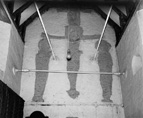
The cross is composed of three stones, one forming the vertical limb, and two others the horizontal limbs. The figure of Christ has been cut back flush with the wall, and there is an irregular concavity in the position of the head. The surviving outline of the figure reveals that it was nimbed, frontally-placed, with the arms stretched out horizontally and the legs straight. Above the cross is the mutilated Hand of God issuing from a cloud, the texture of which is suggested by a series of receding, stepped, undulations. The cloud is carved on three stones wider than, but integral with the string-course of square section which crosses the gable. To the left of the cross the inward-facing figure of the Virgin is carved on a separate stone which abuts the horizontal arm of the cross above, and extends beyond the foot of the cross below. The figure is mutilated but was originally robed, and nimbed. In the corresponding position to the right is the mutilated figure of St John. Only a fold of his robe to the lower right has escaped destruction.
Slessor, writing in 1888, noted that a sculptured hand had been discovered used as filling in the hollow in the position of the head of Christ, probably during the restoration of the annexe by G. E. Street, 1865–6. It is likely that the hand originally belonged to the one of the figures of the crucifixion group. It has since been lost.
It is likely that the area of chiselling at the base of the foot of the cross, just above the west door, represents a feature of the crucifixion group which, like the figures, has been destroyed. The most likely feature is a serpent which occupies this position on the crucifixion at Bitton, Gloucestershire (Taylor and Taylor 1965–78, i, fig. 33).
Carter 1845, 2 - 3, pl. II; Haigh 1846, 412, fig. on 412; ( --- ) 1846; Allen 1887, 247; Slessor 1888, 8, 10, 13 - 14, pl. facing 13; Allen 1889, 198; Nisbett 1891 - 3, 311; Hill 1898, 87; Yarborough 1898 - 1903, 228; Brown 1900a, 308; Brown 1900b, 337; Keyser 1904, liii; ( --- ) 1911; Prior and Gardner 1912, 132 - 3; Jessep 1913, 19; Brown 1925, 351, 458; Doubleday and Page 1903, 239; Page 1911, 398, 429; Porter 1928, 6; Clapham 1930, 140; Cottrill 1931, 52, appendix; Cox and Jowitt 1949, 22, 96; Kendrick 1949, 46; Gardner 1951, 45; Green and Green 1951, 33 - 7, pl. XI; Rice 1952, 99 - 100, 101, 113, pl. 16b; Gilbert 1954, 86; Rice 1960, 198; Quirk 1961, 28 - 9, 33, pl. VI; Fisher 1962, 393; Taylor 1962a, 169; Taylor 1962b, 19; Taylor and Taylor 1965 - 78, i, 291, fig. 128, iii, 1056; Taylor and Taylor 1966, 4 - 6, 12, fig. 1; Pevsner and Lloyd 1967, 285; Gem 1973, ii, 496, 498; Coatsworth 1979, i, 292 - 3, ii, 26 - 7, pl. 149; Fernie 1983b, 150; Rodwell and Rouse 1984, 314, 317 - 18; Tweddle 1986b, i, 73 - 5, 189 - 208, ii, 392 - 4, iii, pl. 52b - 53a; Coatsworth 1988, 170 - 1, 190, pl. 1d; Raw 1990, 53, 208
D.T.