Select a site alphabetically from the choices shown in the box below. Alternatively, browse sculptural examples using the Forward/Back buttons.
Chapters for this volume, along with copies of original in-text images, are available here.


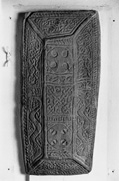
Object type: Grave-cover [1]
Measurements: H. 79 cm (31 in); W. 36 cm (14.2 in); D. c. 10 cm (4 in)
Stone type: Pale greyish-brown, fine-grained sandstone, laminated and with small-scale trough cross-bedding; a Hastings Bed sandstone, Wealden Group, Lower Cretaceous; probably from the Hastings vicinity
Plate numbers in printed volume: Fig. 29; Ills. 10-19
Corpus volume reference: Vol 4 p. 122-123
(There may be more views or larger images available for this item. Click on the thumbnail image to view.)
Grave-cover taking the form of an irregular truncated pyramid on a rectangular base. Only the upper face is carved.
A (top): Enclosing the flat central field is a plain relief frame carried down the angles into the corners, and separating the cabled mouldings along its edges. Each of the five fields thus delimited is further sub-divided into panels (see Fig. 29). Each is decorated in low relief and has a plain raised border. They are designated i–xv as on Fig. 29. Panels i–viii are decorated with interlace. In panels i–iii and viii the interlace is flaccid and disorganized, but in panel viii it conforms to Adcock's basic pattern A. In panel iv two pairs of diagonals interlace where they cross. The point of intersection is encircled by a plain strand which interlaces with the diagonals. In the corners of the panel the end of each diagonal is turned sharply out and back to link with that of its neighbour. A second circular band interlaces with the loops thus formed, and is itself looped between them. In panel v is a tight three-strand plain plait. Field ix is animal decorated. The animal has a ribbon-like, undulating body, with a fan-shaped tail split into three elements. The head has an open mouth, protruding tongue, and an incised eye. In each of the fields created by the undulation of the body is an outward-facing Stafford knot, linked with its neighbours across the animal's body. The loose end of the strand crosses the animal's muzzle and terminates in a loop. In panel x is a similar animal facing in the opposite direction, with its tail split into four, and lacking the strand crossing the muzzle. In panel xi is a Greek cross with expanding, rounded-ended arms drawn out to form an almost complete circle. Between the cross and the corners of the field are U-shaped devices with out-turned ends, their open sides facing the cross. Panel xii is similarly decorated except that straight bars link the cross-arms. Panel xiii contains an angular plant with a triangular leaf in each of the fields created by the regular undulations of the stem. In panel xiv is a plain band with alternate broad and narrow undulations. Panel xv is cable decorated.
It is unclear whether the stone was in situ when discovered; it is unlikely that the possibility of an associated burial was considered at that time.
The form of the monument is unparalleled in south-east England, although it should clearly be grouped with the more three-dimensional forms, such as the coped covers at Headbourne Worthy, Hampshire (no. 2; Ill. 685), Tandridge, Surrey (Ill. 231), and, more loosely, with Winchester, Hampshire (Old Minster 6; Ill. 509).
