Select a site alphabetically from the choices shown in the box below. Alternatively, browse sculptural examples using the Forward/Back buttons.
Chapters for this volume, along with copies of original in-text images, are available here.


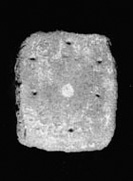
Object type: Part of roundel
Measurements: H. 68 cm (26.8 in); W. 39 cm (15.4 in); D. 34 cm (13.4 in)
Stone type: Pale brownish-grey, shelly, oolitic limestone; Middle Jurassic, of uncertain provenance
Plate numbers in printed volume: Ills. 415, 418-19, 421-2
Corpus volume reference: Vol 4 p. 250
(There may be more views or larger images available for this item. Click on the thumbnail image to view.)
It is of square section and tapers towards the upper end which, like the lower end, is dressed flat.
A (broad): Within a plain relief border moulding, which has a median-incised line except along the upper edge, is a panel of interlace, one complete unit and most of a second, of complete pattern A with rounded loops, turned through 180 degrees, plus a terminal unit at the lower end of the panel; here the two outer strands are left loose and finished with clubbed ends.
B (narrow): The borders are like those on face A, and contains an interlace of complete pattern F, irregularly set out and with a lower terminal in which the outer ends are left loose.
C (broad): Divided into three horizontal zones. The lowest and narrowest is decorated with an interlace of uncertain pattern. The second, twice as high as the first, has a plain raised border. It contains a pair of spiral, inward-facing animals. That on the left is head uppermost, it is open-mouthed, the jaws are pointed and curve upwards, and the eye is marked. The body tapers and is tightly spiralled. The tail is drawn straight from the centre of the spiral, beneath the body, to terminate in the upper left-hand corner of the field in a fan shape, divided into three. A diagonal runs up from left to right, and is bitten by the animal before curling over at the end to touch the second animal. This is similar to the first, but turned upside-down. The third zone has a border like that of the second, and shares a moulding with it. It is divided into two equal fields by a plain vertical moulding, each containing a worn interlace. To the left was apparently a panel of complete pattern F; the pattern of the opposite panel is uncertain, but may have been pattern F with outside strands.
D (narrow): There is a triple plain border which is damaged towards the upper end of the shaft. The face is divided into two unequal fields by a single raised horizontal moulding. The lowest and deepest field contains an interlace of pattern F with outside strands, irregularly set out. The upper field is decorated with a heavily-damaged interlace, possibly also a form of pattern F.
