Select a site alphabetically from the choices shown in the box below. Alternatively, browse sculptural examples using the Forward/Back buttons.
Chapters for this volume, along with copies of original in-text images, are available here.


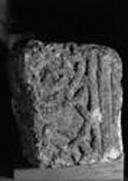
Object type: Fragment of cross-shaft
Measurements: H. 24 cm (9.5 in); W. 44 cm (17.3 in); D. 25 cm (9.8 in)
Stone type: Pale yellowish-grey, medium-grained, shelly, oolitic limestone; probably Barnack stone, Lincolnshire Limestone Formation, Inferior Oolite Group, Middle Jurassic
Plate numbers in printed volume: Ills. 95-97
Corpus volume reference: Vol 4 p. 146
(There may be more views or larger images available for this item. Click on the thumbnail image to view.)
The shaft is of rectangular section and tapers slightly towards the upper end. It is broken roughly horizontally above, and roughly broken below and to the rear, so that face C and approximately half the width of faces B and D are lost.
A (broad): Dressed flat.
B (narrow): There is a pair of broad, plain, low-relief mouldings to the left; the face is decorated with an encircled pattern C interlace, apparently incorporating free rings.
C (broad): Broken away.
D (narrow): Decorated with interlace which probably resembled that on face B, with the border along its right-hand edge.
This is part of a square cross-shaft, but too little survives for it to be clear whether it was originally monolithic, or built in sections, as were other southern English square shafts, such as that from Elstow, Bedfordshire (Ill. 268). It is impossible to tell whether the piece was originally only decorated with interlace, or whether there was a mixture of motifs as at Bishops Waltham, Hampshire (Ill. 421).
The probable use of free rings in the interlace suggests a date in the late tenth or eleventh century, when this feature appears to have originated (Collingwood 1927, 65, 68). The flaccid and disorganised manner of laying-out the decoration supports such a late date.
