Select a site alphabetically from the choices shown in the box below. Alternatively, browse sculptural examples using the Forward/Back buttons.
Chapters for this volume, along with copies of original in-text images, are available here.


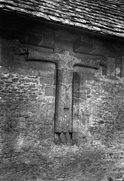
Object type: Crucifixion [1]
Measurements: H. 183 cm (72 in) (W. 216 cm (85 in); D. Built in
Stone type: Pale yellowish-brown, medium- to coarse-grained, shelly, oolitic limestone, with near planar bedding and some calcite veinlets; Combe Down Oolite, Great Oolite Formation of Bath area, Great Oolite Group, Middle Jurassic
Plate numbers in printed volume: Ills. 294-295
Corpus volume reference: Vol 4 p. 213-214
(There may be more views or larger images available for this item. Click on the thumbnail image to view.)
It is composed of four joined elements. The head and lower limb of the cross are made separately, and set with a space between them. Into this gap are inserted tenons on the inner ends of the horizontal arms, which meet on the vertical axis.
The high-relief, frontally-placed, robed figure is intact except for the head. The arms are outstretched at right angles to the body. Each hand rests palm outwards on a vertical bar of triangular section, and is well modelled and deeply undercut. The hands protrude from the hollowed ends of the expanding sleeves of the robe. This has a rounded neck and falls to the ankles. It is tied at the waist with a knotted belt, the long expanding ends of which are cut off square at knee level. There is close vertical ribbing beside the legs. The feet protrude from the robe but are heavily damaged.
