Volume 4: South-East England

Select a site alphabetically from the choices shown in the box below. Alternatively, browse sculptural examples using the Forward/Back buttons.

Chapters for this volume, along with copies of original in-text images, are available here.

Current Display: Langford 03, Oxfordshire Forward button Back button
Overview
Present Location
Built into the median pilaster of the south external face of the tower at first floor level
Evidence for Discovery
See Langford no. 1.
Church Dedication
St Matthew
Present Condition
Heavily weathered
Description
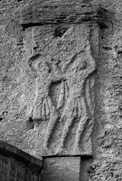
On the lower edge of the trapezoidal panel, which is widest at the top, stands a pair of figures. Each is clad in a knee-length garment and a cloak falling to mid-calf level. Their feet are out-turned, and the legs bent to the right. The figures look upwards and inwards, having their arms bent and raised to grasp the heavily-damaged, narrow, plain raised edge of a semicircular dial whose horizontal edge is co-terminus with the upper edge of the panel. The lines of calibration are lost.
Discussion
It is difficult to decide if this piece is in situ or not. It is placed extremely high up to be read with ease, but could, nevertheless, be read. The figures holding the dial find their best parallels in Anglo-Saxon art of the late tenth and early eleventh centuries, for example, in the Presentation scene in the Foundation Charter of the New Minster, dated to after 966 (Temple 1976, no. 48, ills. 155–6), and the illustrations of the Labours of the Months in BL MS Cotton Tiberius B. V, dated to the second quarter of the eleventh century (ibid., no. 87, ills. 273–4). The architectural features of the tower, in contrast, suggest a later date for its construction. Soffit shafts and rolls which are employed abundantly on the belfry stage were only introduced as late as the second quarter of the eleventh century on the continent (Bony 1967, 75), and their appearance in England before the Conquest would be precocious. The most likely conclusion is that the sundial came originally from an earlier fabric, and has been reused in its present location.
Date
Eleventh century
References
( --- ) 1886, 13 - 14, pl. C; ( --- ) 1899, 52; Gatty 1900, 72 - 3, fig. on 72; Clapham 1930, 138; Cottrill 1931, appendix; Salzman 1939, 367, 371, pl. xxixf; Zinner 1939, 8, 12, abb. 7; Rice 1952, 152; Quirk 1961, 31; Fisher 1962, 229; Taylor 1962b, 19; MacKay 1963, 84, 93; Zinner 1964, iv, 115; Taylor and Taylor 1965 - 78, i, 369 - 70, fig. 167; Taylor and Taylor 1966, 22 - 3, 50, fig. 10; Zarnecki 1966, 91, pl. V; Gem 1973, ii, 501, 503; Sherwood and Pevsner 1974, 348, 681; Tweddle 1986b, i, 84, 175 - 7, ii, 399 - 400, iii, pl. 56b
D.T.
Endnotes

Forward button Back button
mouseover