Volume 4: South-East England
Select a site alphabetically from the choices shown in the box below. Alternatively, browse sculptural examples using the Forward/Back buttons.
Chapters for this volume, along with copies of original in-text images, are available here.
Current Display: Langford 04a–d, Oxfordshire


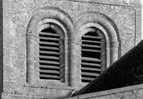
Each face of the tower has a pair of round-headed openings, each of two orders. The outer has quarter-rolls which continue downwards as jamb-shafts; the rolls meet in the middle so that the central jamb continues down as a half-round shaft. The inner order consists entirely of half-round soffit rolls continued as shafts. Between the arches and jambs are continuous strip-like capitals delimited by a narrow, plain moulding of square section below, with a wider one above. Each is decorated with foliate ornament consisting of semicircular groups of leaves, each having a series of narrow, rounded-ended, hollowed elements radiating from the point where it emerges from the lower moulding. Above the central capital, where the quarter-round rolls of the outer order join, there is a larger foliate element of this form.
The architectural features of the belfry stage suggest a date for the tower no earlier than the middle of the eleventh century (see Langford O. (St Matthew) no. 3). The decoration of the capitals and flanking strips, nonetheless, looks back towards Anglo-Saxon art; similar plant decoration occurs widely in the borders of pre-Conquest manuscripts, notably on fol. 4v of the late tenth-century Sherborne Pontifical (Temple 1976, no. 35, ill. 13) and on the scene of the Miracle of the Tribute Money in the Gospel Lectionary fragment formerly in the Musée van Maerlant, Damme, Belgium, dated to c.1000 (ibid., no. 53, ill. 176). Similar compositions are encountered in metalwork, as on the inlaid silver plates around the base of the Canterbury censer cover (Wilson 1964, no. 8, pls. XII–XIV; Backhouse et al. 1984, no. 73, pl. XXII).
Brown 1925, 463; Clapham 1930, 130; Rivoira 1933, ii, 206 - 8; Fisher 1962, 229; Taylor 1962a, 164; Taylor 1962b, 19; Mackay 1963, 83, 90; Taylor and Taylor 1965 - 78, i, 368 - 9, figs. 165 - 6; Taylor and Taylor 1966, 37, 40, 50, fig. 16; Tweddle 1986b, i, 59 - 61, 175 - 6, ii, 400 - 2, iii, pl. 57a
D.T.