Select a site alphabetically from the choices shown in the box below. Alternatively, browse sculptural examples using the Forward/Back buttons.
Chapters for this volume, along with copies of original in-text images, are available here.


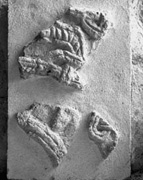
Object type: Three fragments
Measurements: a: H. 12.5 cm (5 in); W. 17.5 cm (6.9 in) b: H. 13.5 cm (5.3 in); W. 12.5 cm (5 in) c: H. 5.5 cm (2.3 in); W. 10.5 cm (4.25 in)
Stone type: Granular limestone (covered with pale yellow limewash), including rounded grains of about 0.4 mm diameter and rod-like bodies 1–2 mm long and many irregular pore spaces; origin uncertain, either Calcareous Tufa from Recent alluvial deposits of the River Test, or a variety of Bembridge limestone, Bembridge Formation, Palaeogene, Isle of Wight
Plate numbers in printed volume: Ill. 447
Corpus volume reference: Vol 4 p. 260
(There may be more views or larger images available for this item. Click on the thumbnail image to view.)
Three irregular sculptured fragments; the edges are all broken and the pieces do not fit together. However, the stone type and decoration are identical and it is probable that they came from the same piece.
a: Sub-rectangular in shape, decorated at the upper end with a pair of crossing median-incised interlace strands. The central portion is decorated with a hatched and contoured tapering animal body curving down from the upper left to lower right, where it is transformed into a median-incised strand interlacing with others.
b: Sub-triangular in shape and decorated with either a double- incised interlace strand, or contoured animal body, curving down from the upper left to lower right, and interlacing with other strands.
c: Sub-rectangular in shape and decorated with two median-incised interlace strands, one looping around the other.
The three fragments have very similar decoration and may come from the same piece. It is impossible to be certain what function that piece served, but the decoration, consisting of hatched and contoured animals enmeshed in interlace, is particularly common on cross-shafts. In Hampshire, there are examples from Upper Brook Street in Winchester (no. 1; Ill. 683), and Steventon (no. 1; Ills. 471–2). It is possible that the fragments were chipped from the decorated faces of a cross-shaft when it was later reshaped for use as building material.
The close comparison between the decoration of these fragments and that of the group of animal and interlace decorated sculptures distributed principally in south-western England serves to place them in the late eighth or early ninth century. This is a date earlier than that which can be suggested for the fragmentary surviving late Anglo-Saxon fabric at Little Somborne.
