Select a site alphabetically from the choices shown in the box below. Alternatively, browse sculptural examples using the Forward/Back buttons.
Chapters for this volume, along with copies of original in-text images, are available here.


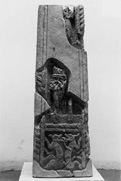
Object type: Part of cross-shaft in two pieces
Measurements:
ai-iii: H. 55 cm (21.7 in) (W. 32 cm (12.6 in); D. 33 cm (13 in)
b: H. 30.5 cm (12 in) (W. 13 cm (5 in); D. 29.5 cm (11.6 in)
Stone type: Pale yellowish-grey, medium- to coarse-grained, shelly oolitic limestone, with a calcite veinlet; Combe Down Oolite, Great Oolite Formation of Bath area, Great Oolite Group, Middle Jurassic
Plate numbers in printed volume: Fig. 33; Ills. 320-340
Corpus volume reference: Vol 4 p. 218-221
(There may be more views or larger images available for this item. Click on the thumbnail image to view.)
The fragments can be reconstructed to form part of a tapering shaft of square section, dressed flat above and below. Fragments a i–iii join. Fragment b apparently belongs to the same shaft. Only face B, and parts of faces A and C survive. There are also traces of red pigment on this stone (Kendrick and Radford 1943, 14; Tweddle 1990, 151).
Fragment a.
A (broad): Along the left and right-hand edges is a bold cable moulding of fundamentally square section, the strands are well modelled and have a V-shaped median groove. Inside each is a narrow, plain raised moulding of square section. Along the lower edge a broad, plain raised moulding of rectangular section partially survives, broken away to the left and right. The face is divided into two unequal fields by a broad, plain horizontal moulding of rectangular section with a wide, deep incised median line stopping short of the vertical mouldings and widening abruptly short of its left-hand end; the right-hand end is damaged. Just short of each end a pair of oblique incised lines emerge from the median line, one above and one below, and run into the corners of the moulding. In the lower, smaller, field is a pair of addorsed animals facing inwards. That to the left has its mouth open, the ends of the jaws are out-turned, and the head bulges over the prominent incised reversed lentoid eye. The ear has its end curled down. The narrow body curves towards the vertical axis of the field where it touches that of the second animal before curving out again. Three incised lines span the width of the body just above the hindquarters, which rest on the lower border. The rear legs are bent at the knee and the paws placed against the border, while the front legs are also bent and the paws placed against the border; the toes are indicated by incised lines. The second animal is a mirror image of the first except that the ear is longer and the end up-turned. The protruding tongues of the animals are linked and drawn out across the body of the right-hand animal. In the upper, larger, field is the lower part of a robed figure, surviving to the left from mid-thigh level and to the right from knee level. The upper part of the knee-length robe has close vertical ribbing and is separated by a pair of narrow horizontal mouldings from the lower part of the garment which expands and is composed of a series of stiff vertical folds. Each of the bare legs, in high relief and with a degree of undercutting, is separated by a pair of narrow horizontal mouldings from the frontally-placed unshod foot. The toes are indicated by incised lines. The feet rest on a broad plain zone recessed behind the borders. The area between the legs, and between the legs and the frame is further recessed and bears the heavily-damaged inscription.
Inscription The inscription (Ills. 323–4, 327; Okasha 1971, 99–100; eadem 1992b, 341, 345) is in two lines divided into three vertical sections by the legs of the standing figure. The letters vary in height from about 4.3 cm (1.7 in) for the R of the upper line to 2.8 cm (1.2 in) in the lower line. There is now no colour visible in or near the lettering. The inscription can be transcribed as follows:
[.E] || [RH] || [E.]
[--] || ǷOR || RD
This can be edited as:
ERH[E.--]ǷORRD
(or perhaps [Ƿ]ERH[E.--]ǷORRD)
The interpretation of this text is uncertain. The damaged first letter could well have been part of Ƿ. It is also possible that this is not the beginning of the inscription and that it originally started higher on this face. About two letters are likely to have been lost at the start of the second line. The last element may represent the Old English word ('word', possibly in the Christian sense of the 'word of God' or the 'Word' (Okasha 1971, 100)). Alternatively, the whole or part of the text may have been a personal name, although it does not correspond to known Old English personal names. (Radford read 'WERHENWORRTH' and took that to be a personal name. That reading ignores the gap at the beginning of the second line and reads D as eth (Kendrick and Radford 1943, 16).)
The lettering is damaged and somewhat irregular. It may have been a little awkward cutting letters on the recessed ground close to the high relief of the legs. The serifs tend to be wedge-like in form. As far as they can now be judged, the letters seem to show more departures from normal Roman capital forms than other pre-Conquest inscriptions on stone in the south-east of England. D is the uncial letter (which is also used in Insular half uncial). It is open at the top and has a slight angle at the base. E is the Roman capital form. H is a non-capital form which is closer to the Insular half uncial than to the uncial letter in that the lower part of the right-hand stroke straightens out into a near vertical rather than continuing to curve (cf. Higgitt 1979, 361–2). The O is oblong, a rare form in Anglo-Saxon inscriptions on stone. Two forms of the capital R are used: with the bow open at the bottom; and with the bow meeting the right leg half-way along its length. Runic wynn is used for W.
B (narrow): Only the decoration on stone a i survives. It is framed like face A. The decoration is divided into two unequal fields. The lower, smaller field, heavily damaged and apparently undecorated, lies flush with the inner frames and is separated from them by incised lines. Inside them the field has a further narrow plain frame defined by incised lines. The upper, larger, field is ornamented with a well-ordered six-strand plain plait; the broad strands are median-incised and the central crossing point at the bottom contains a pellet.
C (broad): The decoration on stone a ii is obliterated, and that on stone a i heavily damaged. Face C of stone i has borders like those of face A, the mouldings being largely destroyed. It is decorated with the lower part of a robed figure surviving from approximately knee level. Beside each border an edge of the robe falls in stiff vertical folds which flank a plain, vertical, median zone. From the lower end of the robe, foreshortened and portrayed as an oval, protrude the legs of the figure. The feet are out-turned.
D (narrow): The border mouldings are like those on face A, and the lower third of the face is ornamented with foliate decoration. From the lower corners of the face emerge narrow, diagonal plant stems, three from the right and two from the left, interlacing where they cross and terminating in pointed, oval, berry bunches. Each stem is median-incised and between the stems to the left are two short, expanding rounded-ended, hollowed leaves. The upper two-thirds of the face are occupied by a pair of elongated robed figures, side by side, and surviving from shoulder level. Each is clad in a horizontally-ribbed undergarment, with a vertically-ribbed overgarment thrown over the shoulders and gathered up across the body. The legs are clad in a close fitting trouser-like garment, laterally ribbed, which terminates at the ankle in a pair of narrow horizontal mouldings. The out-turned feet are shod and rest just above the foliate decoration. At ankle level the face is abruptly recessed allowing the legs to be treated in high relief with a degree of undercutting. The left-hand figure holds in its right hand a key. The right-hand holds an unidentified feature.
Fragment b.
A (broad): Along the right-hand edge is a prominent cable moulding identical to those on stone a i and ii. Only a marginal fragment of the decorative field survives, apparently ornamented with part of a robed figure. The robe has close lateral ribbing.
B (narrow): The heavily-damaged edges have borders like those on face A, the face being decorated with two interlaces separated by a narrow, undecorated zone. Each is composed of broad strands with a median-incised line. The lower, cut off by the break below, is an eight-strand plain plait. The upper, cut off by the break above, is probably pattern D with an additional diagonal strand through the element.
C (broad): The surviving, left-hand, border resembles that of face A. The field is ornamented with the shoulders of a robed figure, the robe having close lateral ribbing. Traces of red paint survive in the ribbing.
D (narrow): Broken away.
It seems clear that fragment 1b belongs to the same shaft as fragments 1a i and ii, although in the reconstruction of the shaft it has not necessarily been placed in the correct relationship to the other fragments.
An eleventh-century date for this shaft can be argued both from the iconography and from the handling of the figures and their drapery. Iconographically there is the use of what is probably a pair of seated figures in secular dress on face D (Ill. 336). The use of secular dress may in itself point to a late pre-Conquest date for the shaft;[1] it occurs in manuscript illustrations of the tenth and eleventh centuries, for example, in Cambridge, Corpus Christi College MS 183, fol. 1v, of the early tenth century, and fol. 2v of BL MS Cotton Tiberius A. III, a work of c. 1050 (Temple 1976, no. 100, ills. 29, 313). Similarly, the use of very elongated figures on no. 1 also finds its best parallel in the eleventh century, as in the Judith of Flanders Gospels (ibid., no. 93, ills. 285, 289) and Monte Cassino, Archivio della Badia MS BB. 437, 439, made c. 1050 (ibid., no. 95, ill. 287).
The folds of the robes on no. 1 are rigid and formalized, losing contact with the shape of the body beneath, and frequently employing nested U-shapes. This approach is closely paralleled in some eleventh-century manuscripts, notably in Aelfric's Pentateuch, a product of St Augustine's abbey, Canterbury, and dating to the second quarter of the eleventh century. This handling of the draperies occurs also on other sculptures of the late Anglo-Saxon period, most obviously on the tenth- or eleventh-century cross-shaft from Shelford, Nottinghamshire (Kendrick 1949, 78–9, pl. LI). Here the robes of the Virgin and Child and those of the seraph on the opposite face share with the robes of the figures on no. 1 the use of narrow, closely spaced grooves to indicate the folds of the garment, again arranged in formalized patterns rather than naturalistically.
Inscription The unusual oblong form of O can be best paralleled in eighth-century examples from Hartlepool, co. Durham, York, and also Hackness, Yorkshire (Okasha 1971, pls. 46–7, 151; Cramp 1984, i, 99–100, ii, pl. 84 (436), 85 (440); Higgitt in Lang 1991, 138). (Okasha's late, probably eleventh-century, example at Aldbrough, Yorkshire (Okasha 1968, 323) is not borne out by an examination of the stone.) The letter is one of the forms used in the display script of Insular manuscripts of around the eighth century (see for example Gray 1986, 242–4, 247; Higgitt 1994, 229).
The general impression given by this lettering, with its wedge-like serifs, which probably reflect the fashion for wedge serifs in Insular book scripts of around the eighth century, and its letter forms, particularly the oblong O, suggests that it dates from a period in which early Anglo-Saxon traditions in lettering were still remembered. The eleventh-century date argued for this sculpture on other grounds (see above) seems remarkably late for lettering of this sort, particularly in the south of England. Anglo-Saxon inscriptions on stone of the tenth and eleventh centuries and the display scripts of southern English manuscripts of the same period favour a much more consistent use of Roman capitals with a few variants (e.g. Okasha 1971, pls. 1, 15, 28–9, 41, 64, 111, 146; Temple 1976, ills. 18, 26, 38–40, 54, 57, 70–5, 81, 83, 92–3, 113–17, 125–8, 133, 138–40, 152, 182, 200, 216–23, 232, 260, 262, 288, 290–1, 296–7, 300, 319; Heslop 1990, 162–5). Whilst lettering like that on this fragment might have survived into the eleventh century, there seem to be no parallels in contemporary manuscripts or stone inscriptions. A dating to around the ninth century would be more natural on epigraphic grounds, although a later date cannot, of course, be excluded.
The setting of an inscription within the sculptural field is relatively unusual in Anglo-Saxon stone sculpture but there are analogies (though none is exact) at Auckland St Andrew 1 and Chester-le-Street 1 in co. Durham (Cramp 1984, ii, pls. 3 (6), 20 (102)), Ipswich in Suffolk (Okasha 1971, pl. 58), Newent in Gloucestershire (eadem, pl. 94a), and Great Urswick in Lancashire (Bailey and Cramp 1988, ill. 564; Page 1987, 38; Higgitt 1986, 131).
