Select a site alphabetically from the choices shown in the box below. Alternatively, browse sculptural examples using the Forward/Back buttons.
Chapters for this volume, along with copies of original in-text images, are available here.


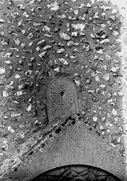
Object type: Sundial [1]
Measurements: H. (visible) [2] c. 55 cm (21.5 in); W. c. 38 cm (15 in); D. Built in
Stone type: Pale yellow and grey mottled, fine-grained limestone, packed with fine arcuate shell fragments preserved in calcite; Quarr stone transitional to Bembridge limestone, Bembridge Formation, Palaeogene, Tertiary; Isle of Wight
Plate numbers in printed volume: Ills. 6-7
Corpus volume reference: Vol 4 p. 124-125
(There may be more views or larger images available for this item. Click on the thumbnail image to view.)
The dial has a semicircular head and straight sides which diverge towards the base; the latter is overlapped by the apex of the concrete revetment to the south door (Ill. 6). Three incised lines parallel the edge of the stone, and a pair of incised lines delimits the lower edge of the circular dial, the upper edge of which is formed by the head of the stone. In the centre of the dial is a large, irregular gnomon hole. (A new gnomon has been cemented into this hole recently (Ill. 7).) The lower half of the dial is calibrated using incised lines. The lateral lines, just above the horizontal, the vertical line, and the pair of lines at 45 degrees, all have crossed ends. The ends of the cross-arms and the principal lines are drilled. Between each pair of principal lines are two equally-spaced shorter lines also with drilled ends. The upper half of the dial is uncalibrated. Immediately inside the triple-incised edging there is an incised marginal fret.
Inscription The inscription (Okasha 1971, 54; eadem 1992b, 342, 344) is incised into the semicircular area at the top of the stone above the dial. It is arranged asymmetrically in two horizontal lines. The inscription is much more deeply cut than the surrounding decoration. This suggests that the inscription could have been recut at some date. Any recutting cannot, however, have been very recent, to judge from the weathering. A possible time for such work would have been during the restoration of 1848 (Figg 1849, 276, 279; idem 1854, 61).
The inscription opens with an introductory cross and two widish points mark the end of the text. The letters are 4 cm (1.6 in) in height and are capitals. They can be transcribed as follows:
+ E A D
R I [C]
The text must be the common Old English personal name Eadric (Searle 1897, 186–8; Feilitzen 1937, 233–6).
The letters are neatly executed but their spacing is a little irregular: cramped in the first line and spacious in the second. The layout suggests an inexperienced designer. A has a bar across the top that meets the diagonals shortly before the point at which they would converge. The last letter looks more like a Roman G than a C; the short vertical rising from the bottom right-hand end of the letter is quite distinct. G for palatalized k would, however, be a remarkable spelling.3 The short vertical could be due to an error or could be the result of the possible recutting suggested above. Whether the letter intended was C or G, it is the standard Roman form. The E and the A (and perhaps also the D) have dot serifs (Okasha 1968, 332) that look as if they have been produced with a drill or by revolving a mason's point. Similar dot-like sinkings decorate the terminals of the introductory cross and the plain cross terminals of the dial lines.
The dial has a semicircular head and straight sides which diverge towards the base; the latter is overlapped by the apex of the concrete revetment to the south door (Ill. 6). Three incised lines parallel the edge of the stone, and a pair of incised lines delimits the lower edge of the circular dial, the upper edge of which is formed by the head of the stone. In the centre of the dial is a large, irregular gnomon hole. (A new gnomon has been cemented into this hole recently (Ill. 7).) The lower half of the dial is calibrated using incised lines. The lateral lines, just above the horizontal, the vertical line, and the pair of lines at 45 degrees, all have crossed ends. The ends of the cross-arms and the principal lines are drilled. Between each pair of principal lines are two equally-spaced shorter lines also with drilled ends. The upper half of the dial is uncalibrated. Immediately inside the triple-incised edging there is an incised marginal fret.
Inscription The inscription (Okasha 1971, 54; eadem 1992b, 342, 344) is incised into the semicircular area at the top of the stone above the dial. It is arranged asymmetrically in two horizontal lines. The inscription is much more deeply cut than the surrounding decoration. This suggests that the inscription could have been recut at some date. Any recutting cannot, however, have been very recent, to judge from the weathering. A possible time for such work would have been during the restoration of 1848 (Figg 1849, 276, 279; idem 1854, 61).
The inscription opens with an introductory cross and two widish points mark the end of the text. The letters are 4 cm (1.6 in) in height and are capitals. They can be transcribed as follows:
+ E A D
R I [C]
The text must be the common Old English personal name Eadric (Searle 1897, 186–8; Feilitzen 1937, 233–6).
The letters are neatly executed but their spacing is a little irregular: cramped in the first line and spacious in the second. The layout suggests an inexperienced designer. A has a bar across the top that meets the diagonals shortly before the point at which they would converge. The last letter looks more like a Roman G than a C; the short vertical rising from the bottom right-hand end of the letter is quite distinct. G for palatalized k would, however, be a remarkable spelling.3 The short vertical could be due to an error or could be the result of the possible recutting suggested above. Whether the letter intended was C or G, it is the standard Roman form. The E and the A (and perhaps also the D) have dot serifs (Okasha 1968, 332) that look as if they have been produced with a drill or by revolving a mason's point. Similar dot-like sinkings decorate the terminals of the introductory cross and the plain cross terminals of the dial lines.
The dial belongs to a group of sundials having the circular dial fitting into the semicircular head of a basically rectangular slab, a form adopted also at Marsh Baldon in Oxfordshire (Ill. 358). The calibration falls into the standard pre-Conquest pattern, with only the lower half of the dial calibrated, and the principal, mid-tide, lines crossed near their ends.
The dating of the piece derives principally from the fact that it is in situ in a fabric which the Taylors place before c. 950 (Taylor and Taylor 1965–78, i, 71–2). Fernie, however, is less precise, allowing a pre- or post-Viking date (Fernie 1983b, 178). An early date is supported by the use of fret decoration; frets are rare in late Anglo-Saxon art in southern England, but commonplace in the ninth century and earlier.
Inscription If the last letter is a G, it is in a Classical and Carolingian form which is fairly unusual in Anglo-Saxon inscriptions but can be found on the dedication inscription of 1056 at Deerhurst, Gloucestershire, and apparently on the probably tenth-century brooch from Cuxton, Kent (Gray 1986, figs. 11, 18, 24, 67, 68, 70, etc.; Okasha 1971, pls. 27–8; Wilson 1964, 129–30). The form of the serifs is unusual, dot serifs being rare in Anglo-Saxon inscriptions. (For a full discussion and references, see London (All Hallows by the Tower) no. 1.) The serifs of R and I seem to have been of a more usual chisel-cut type. This difference may simply have been due to the craftsman's desire for decorative variation. Alternatively, these serifs might have been introduced at the stage of the hypothetical recutting of the stone.
Eadric could be either the craftsman or, more probably, the patron of the dial (or of the church in general), to judge from names recorded in fuller texts on sundials in Yorkshire at Great Edstone (maker formula) and Kirkdale (patronage and maker formulae) (Okasha 1971, 73, 87–8; Higgitt in Lang 1991, 134–5, 164–6). The name is too common to make attempts at identification worthwhile.
There are other sundials with inscriptions across the top of a semicircular dial, at Great Edstone, Kirkdale, and Old Byland, Yorkshire (Okasha 1971, pls. 41, 64, 98; Lang 1991, ills. 451, 453, 568, 570, 729–30), and possibly formerly at Leake, Staffordshire (Okasha 1971, pl. 72).
