Select a site alphabetically from the choices shown in the box below. Alternatively, browse sculptural examples using the Forward/Back buttons.
Chapters for this volume, along with copies of original in-text images, are available here.


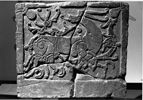
Object type: Grave-marker, in four joining pieces [1]
Measurements: H. 47 cm (18.5 in); (W. 57 cm (22.4 in); D. 10 cm (4 in)
Stone type: Pale yellowish-grey, medium-grained, oolitic limestone; probably Combe Down Oolite, Great Oolite Formation of Bath area, Great Oolite Group, Middle Jurassic
Plate numbers in printed volume: Ills. 350-352
Corpus volume reference: Vol 4 p. 226-228
(There may be more views or larger images available for this item. Click on the thumbnail image to view.)
It is rectangular and tapers slightly towards the base. It is broken into four. The lower part is separated by a break undulating from left to right, and is broken into two roughly equal parts by a vertical break. From slightly to the left of the point of junction of the breaks a third break rises steeply to the right and divides the upper portion into two unequal parts.
A (broad): There is a narrow, damaged, plain raised border along the upper edge and a similar, slightly wider one along the left- and right-hand edges; what now appears to be a broad low-relief border along the lower edge is probably the result of modern recutting (cf. Ills. 351 and 352). In each of the upper corners a low-relief bulbous device protrudes into the decorative field, tapering towards the corner, where it is separated by a collar from a pair of strands defined by incised lines, one of these crosses the upper border, and the other the lateral one. Occupying the decorative field is a prominent Ringerike-style animal in low, flat relief, moving to the right, but looking to the left. The head is separated from the neck by a tight incised spiral, it is narrow, with a long muzzle and open mouth. The canine teeth are indicated. The long thick tongue with an up-curled end protrudes. The animal's forehead bulges over the incised reversed lentoid eye, and from the top of the head a pair of tapering lappets with up-curled ends are drawn back. The inner edge of the boldly-curving neck is continuous with the animal's horizontal back, and its belly tapers towards the rounded hindquarters. The hip-joint is indicated by an incised spiral, and both of the tapering legs are indicated. The nearside leg, bent slightly forwards, terminates in a long claw, divided into two by an incised line, which curls under to almost touch the lower edge. The offside leg angles to the right and terminates in a similar claw. The animal's tail is brought down to interlace with the hind legs, as do a number of narrow, tapering, foliate tendrils, each with a tightly curled tip. Above the hindquarters a number of similar foliate sprays interlace together, and one is looped around the animal's body. The nearside shoulder joint is indicated by an incised spiral, the tapering leg angles to the right and terminates in a curved claw, divided into two by an incised line. The offside leg angles to the left and crosses over it. A strand brought across from the rear legs and from the interlace above the hindquarters interlaces with and loops around the front leg, and a stem is brought up in front of the animal. This develops into a tight scroll facing the animal and the head and neck of a second animal facing right. It has a long muzzle and a open mouth with an incised reversed lentoid eye. A long tapering lappet is drawn back from the top of the head. Extensive traces of paint survive applied on a thin plaster ground. The colours are red, blue and white.
B, C, E, and F: Dressed flat.
D (narrow): Inscription This edge of the stone carries a two-line inscription in Scandinavian runes. The characters run up the left side of the surface and down the right, covering the whole width. Their bases face inwards and there is a dividing line in the middle where they meet:
:[k.]na:let:lekia:st
in:þe(nsi):auk:tuki:
The only real doubt about the text of the inscription attaches to the initial name, where damage has obliterated part of the first and all of the second rune. Moreover, in the younger Viking-age futhark there are only sixteen characters, each of which can denote several sounds. It is likely, though, that what we have here is Ginna, probably a familiar form of the female name Ginnlaug, recorded on several Swedish rune-stones. The text would then be as follows (in the normalized form usually adopted for the presentation of Danish and Swedish runic inscriptions):
Ginna let laggia sten þensi ok Toki.
(Translation: 'Ginna and Toki had this stone laid.')
The stone was originally c. 30 cm taller, the lower portion being roughly dressed for insertion into the ground. Of this the lower left-hand part was broken away during excavation, and thrown back into one of the trenches. The rest was probably removed when the stone was mounted for display in the warehouse, the construction of which led to its discovery.
It has been suggested that this piece is part of a box tomb or sarcophagus (Wilson and Klindt-Jensen 1966, 135). When discovered, however, there were no other pieces with it, as might have been expected with a box tomb. Moreover, it is clear that the lower, undecorated, portion was originally inserted into the ground to hold the stone upright. This is a feature not seen on Scandinavian box tombs. At Ardre, for example, the sides of the tomb rested on the ground, and the structure was held upright by the mutual support of the slabs, possibly with the aid of mortar in the joints (Graham-Campbell 1980b, 160–1, no. 538, pl. 538). On a grave-marker, however, the division between the visible, decorated, element, and the undecorated element, which was buried, is a consistent feature. It is, therefore, preferable to interpret the piece as a head- or foot-stone.[2]
The decoration is in the Ringerike style, current in Scandinavia from the late tenth century to the third quarter of the eleventh century (Wilson and Klindt-Jensen 1966, 145–6). In England the style can probably be tied to the period of Scandinavian ascendancy, from 1016–42 (ibid., 145). Pieces from London (City 1 and All Hallows by the Tower 3), Rochester in Kent (nos. 2–3), and Great Canfield 1 in Essex (Fig. 32), are also decorated in the Ringerike style. Their restricted distribution, use of this style, and the similar technique of carving suggest that they are products of the same workshop.
Inscription It is odd that there is no mention of the person in whose memory the inscription was made, nor of his or her relationship to Ginna and Toki, but it is possible that only part of what was once a much longer inscription survives. If this stone formed the upright gable of a composite tomb, there would have been a second gable at the end of the ledger, and this (and/or the ledger itself) may have carried a continuation of the inscription. [3] (Under the less plausible interpretation of the sequence auk:tuki as (h)ǫgg Toki ('Toki cut [the runes]') - which, with its loss of initial /h/ presupposes a Swedish carver (see below) - one would not expect there to have been a continuation since the statement 'NN cut' typically concludes an inscription.)
Rune types and orthography (the occurrence of *; * for /o/), language (the mixture of monographic and digraphic forms: stin v. auk), and wording (with let læggia for the more common late Viking-age let ræisa ('had raised')), combine strongly to suggest an early eleventh-century date for the inscription. The ornament on the face of the stone, which seems to be a development of that found on a number of late tenth-century Danish stones, including the famous Jelling 2 (Jacobsen and Moltke 1941–2, I, col. 478; Moltke 1985, 322–5), supports such a dating. The carver must almost certainly have been a Dane or a Swede (it is impossible to determine which), perhaps one who came over to England at the time of Cnut; a monument so typically Scandinavian can scarcely have been made by a descendant of one of those Vikings who settled in England in the ninth century. In view of this it is probable that the person commemorated was also of Scandinavian birth.
[n. 2] It is conceivable that the piece might have formed part of a composite monument, with head- and foot-stones separated by an intervening recumbent grave-cover, comparable to the one excavated from Winchester (see Old Minster nos. 2 and 6). This might then explain the possibly incomplete nature of the inscription (see below), for the recumbent component of the Winchester assemblage (Old Minster no. 6) is also inscribed (though in this case the inscription is apparently complete in itself).
[n. 3] See above, note 2.
