Select a site alphabetically from the choices shown in the box below. Alternatively, browse sculptural examples using the Forward/Back buttons.
Chapters for this volume, along with copies of original in-text images, are available here.


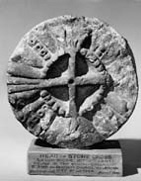
Object type: Cross-head
Measurements: Diameter 26 cm (10.2 in); D. 15 cm (5.9 in)
Stone type: Medium grey, finely glauconitic, sandy limestone, with some small dark grey inclusions that may be phosphatic nodules; Kentish Ragstone, Hythe Beds, Lower Greensand Group, Lower Cretaceous; Maidstone area
Plate numbers in printed volume: Ills. 347-349
Corpus volume reference: Vol 4 p. 225
(There may be more views or larger images available for this item. Click on the thumbnail image to view.)
It is a plate-head of narrow rectangular section. Only the broad faces are carved.
A (broad): The deeply dished centre is surrounded by a narrow relief moulding of indeterminate section, sub-divided by incised lines. The face of each sub-division is convex. This in turn is surrounded by a broad outer zone, subdivided radially. The face of each subdivision is convex, and the narrow mouldings forming the diagonals are pelleted; each pellet has a drilled centre. Superimposed on this is a cross formed from a pair of narrow relief mouldings drilled at the point of intersection. From the narrow moulding encircling the dished centre each arm expands; the expansions are subdivided lengthwise by incised lines.
C (broad): As face A, except that the marginal moulding of the central dishing is plain and the outer ends of the narrow mouldings forming the cross do not expand, but terminate on the edges of the face. The broad outer zone is also treated rather differently. The lower right-hand quadrant is divided into six parts of which the two outer and two middle parts are plain, and the remaining parts pelleted; the pellets are drilled. The upper left-hand quadrant is divided into eight parts of which the two middle pairs are pelleted; the pellets are drilled.
This piece illustrates the typological relationship between the plate-head and the ring-head, since on it the arms of the cross are linked by a relief ring and the area between the ring and the narrow arms is deeply hollowed, but not pierced as it would be on a ring-head. The small size of the piece suggests that it may have performed a memorial function.
The relationship between ring-heads and plate-heads such as this serves to place the piece in the tenth or first half of the eleventh century (Collingwood 1927, 137–9, fig. 153; Bailey 1978, 178–9). The nature of the decoration adds little to a discussion of date, but the use of rows of pellets is not encountered elsewhere among the pre-Conquest sculpture of south-east England. They do appear frequently on Romanesque sculpture, and may serve to suggest a late date for the piece. It is, however, very insubstantial evidence.
