Select a site alphabetically from the choices shown in the box below. Alternatively, browse sculptural examples using the Forward/Back buttons.
Chapters for this volume, along with copies of original in-text images, are available here.


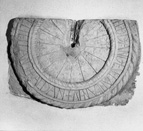
Object type: Sundial
Measurements: H. 45 cm (17.7 in); Diameter 64 cm (25.2 in); D. Built in
Stone type: Pale grey, fine-grained sandstone, with scattered 0.1-mm glauconite grains and mica flakes; Reigate stone, Upper Greensand, Gault Group, Lower Cretaceous
Plate numbers in printed volume: Ills. 105-107
Corpus volume reference: Vol 4 p. 147-149
(There may be more views or larger images available for this item. Click on the thumbnail image to view.)
The stone is described and illustrated as originally intended to be seen, and not as reset. Only one face is visible.
The dial is circular and the surround is carved on a sub-rectangular panel, the upper third of which has been broken away. The break is horizontal. The frame of the dial consists of a pair of cable mouldings twisted in opposite directions; the strands are well modelled and median-incised. These mouldings are separated from a broad, flat, slightly recessed zone by a pair of narrow roll mouldings. The recessed face of the dial has a central drilled gnomon hole. The area around it is damaged and linked to the upper edge of the stone by a (presumably secondary) vertical U-shaped channel, the edges of which have been roughly chamfered. Thirteen equally-spaced lines calibrate the whole of the surviving portion of the face, each terminating on the frame. The horizontals, the surviving vertical, and the lines equidistant between the horizontals and the verticals are crossed by short incised lines close to their outer ends.
Inscriptions The dial bears four incised texts. Three of these (a–c) are in Latin lettering and are fragmentary (Okasha 1971, 105). The fourth (d) is in runes and is incomprehensible (Page 1964, 70; idem 1967, 289–91). Two of the texts in Latin lettering (a and b) run around the sunken flat annular field set between mouldings that frame the dial, both originally starting at or near the top of the dial. These letters occupy the full available height, that is to say, between 5 and 5.3 cm (2 and 2.1 in). The beginnings of both of these texts were lost with the top of the dial. The feet of the letters in text a face towards the centre of the dial and ran round its right side; those of b face away from the centre and were on the left. The two texts end neatly at the bottom of the stone and are separated by an incised cross placed on what was presumably the vertical axis of the stone. The third text, c, is set in the upper half of the face of the dial. The upper half of the circle seems, like the lower half, to have been divided into eight sectors by lines radiating from the centre. One letter is set in each of the surviving sectors. Six letters remain wholly or in part; probably two more are missing at the top from the middle of the text. The first two letters of this text are 4.2 cm (1.7 in) and the last two are 4 cm (1.6 in) in height. The feet of the letters face towards the centre. Text d consists of three characters, probably all runes, in the lower half of the face of the dial. They occupy the three of the eight sectors into which the lower half is divided that are furthest to the left. The runes are about 4 cm (1.6 in) high. The feet of the runes face away from the centre of the dial.
Texts a and b are in capitals and the language is Old English. They can be transcribed as follows:
(a)--[Æ]CÐÐANÐESECAN[C]AN/HV+
(b)--.E]LTE[LLAN⁊H/EA]LDAN
These can be edited as follows:
(a)--[Æ]CÐ ÐAN ÐE SECAN CAN HV +
(b) --EL TE[LL]AN ⁊ HEALDAN
The texts have been translated as follows. (a) 'to (or 'for') him who knows how to seek out how' (Page 1967, 290 - 1) or 'for him who knows how to seek (it)' (Okasha 1971, 105). --[Æ]CÐ can perhaps be restored as tæcð 'shows' or 'teaches'. The meaning might then be '... shows him who knows how to seek'. (b) '... to count (or 'to tell') and to hold' (Page 1967, 290). All that remains of the fragmentary letter at the start of this section of text is part of a horizontal at the top. In the context angular S is perhaps the most likely reconstruction, because the first surviving word could then be read as sēl (the adverb 'better'). These texts presumably relate to the function of the sundial and were perhaps to be read together as a single text. A possible interpretation of the two lines taken together might then be: '[This dial shows] to him who knows how to seek, how [better] to reckon and keep [the time]'. Given the layout, it would be more natural to start with text (a), which reads downwards clockwise from the top.[1]
Text (c) is in capitals and the following is the most conservative transcription:
OR[.--.]VM
All that remains of the third letter is the bottom of a rightward sloping diagonal. This is most likely to have been the bottom of the left leg of a capital A. Two letters are probably missing from the top two sectors. The fragment of a letter before VM is almost certainly the lower right-hand section of an angular G. The ending suggests that this is a Latin neuter singular. As Page proposes, this is presumably a form of the Latin (h)orologium, 'clock' or, in this case, 'sundial' (Page 1967, 291). He suggests that the spelling on the stone was probably ORALOGIVM and that the sixth sector contained both the letters G and I, side by side or with the I within the G. The latter is the more likely. The inscription is likely therefore to have read either OR[ALOGI]VM or OR[ALOG]VM. Although it does involve placing two letters in one sector, the spelling oralogium looks more probable. Furthermore, it seems to have been used in the tenth-century addition to the Leofric Missal (Warren 1883, 58).
Text (d) consists of three characters. The first, reading left to right, could be the Anglo-Saxon rune 'æ', although in that case the stave is irregularly extended above the junction with the upper diagonal. It is in fact closer in appearance to the Scandinavian rune o. Page compared the second character to the variant of the Anglo-Saxon 'œ' rune found on the Thames scramasax (Page 1967, 290) and in some manuscripts. It is not, however, identical to the Thames rune, being rounded and not angular in form. It is closer in form to a Danish m, which appears commonly with rounded bows but is generally rather narrower in proportions than this character. The third character is a neat and well-formed Anglo-Saxon 'o' rune. This last character is sharp and neat, but the other two are less so. Indeed, the first is rather small and poorly executed. No obvious reading of this 'text' suggests itself and it is quite possible that they were not all cut by the same hand. The asymmetrical placing of text (d) contrasts with the balanced layout of texts (a–c) and may indicate that all three characters were secondary.
The lettering of inscriptions (a–c) is well executed. The strokes of the letters are of even breadth. The letters either lack serifs altogether or are only very slightly seriffed. The lettering is somewhat elongated, especially in the densely packed texts of (a) and (b). Space is also saved in (a) and (b) by the use of ligatures (once in each). The forms of the capitals are Roman with the following exceptions: A with an angular cross-bar (as well as Roman A); angular C; M with vertical sides and a very shallow central 'V'; N with the diagonal meeting the verticals short of the ends (as well as the Roman form); and angular S. In addition, angular G was probably used in inscription (c). Old English eth appears both in the usual form as Roman D with a horizontal bar through the vertical, and as Roman D with a horizontal bar through the bow.
There is no word-division nor any use of points. A cross is used to mark the ends of (and to separate) texts (a) and (b). The texts are unabbreviated apart from the use of the Tironian symbol for and or ond in text (b).
Apart from the possible implications of the inscriptions, only the cabled moulding encircling the dial provides any hint as to the possible date of the stone. This has modelled strands, each with a median moulding of V-shaped section, precisely the form used on Little Munden 1, and on Walkern 2, both in Hertfordshire, Dartford 1 in Kent, and London (All Hallows by the Tower) 1, for most of which a late tenth- to mid eleventh-century date can be argued.
Inscriptions The lettering (Ills 105–7) is similar to that at Breamore, Hampshire (Ills. 430–3), in the even line, the lack of serifs, the tall proportions, and the use of Roman forms with one or two angular variants. It is perhaps roughly contemporary with the lettering of Breamore, which was carved on an arch of the later tenth or earlier eleventh century.
There are several other inscribed stone sundials from pre-Conquest England, one at Bishopstone in Sussex (Ills. 6–7) and the rest in Yorkshire. Most (perhaps all) of these date from late in the Anglo-Saxon period. The majority of the dials are semicircular. The best formal parallels are provided by the (probably eleventh-century) circular sundial at Aldbrough, Yorkshire, and the fragmentary dial of the later eleventh or early twelfth century at Stow, Lincolnshire. These dials have texts set in an annular framing field. At Aldbrough the text goes right round the dial, which was probably also formerly the case at Stow, and at both the feet of the letters point towards the centre (Higgitt in Lang 1991, 123, ill. 418; Okasha 1992a, 54, pl. VId). The dial at Leake, Yorkshire, also has an annular framing field part of which shows traces of what may have been lettering (Okasha 1971, 92, pl. 72).
The three partially comprehensible texts on this sundial are probably related to its function. The Latin texts can be compared to the one which runs across the top of the semicircular dial at Great Edstone, Yorkshire. This probably read '+ ORLOGIV[M V]IATORVM' (Higgitt in Lang 1991, 134–5, ill. 453). In their incomplete state, the Old English texts (a) and (b) are more cryptic, but references to special knowledge and perhaps to computation (tellan) might have been thought appropriate on the new sundial. Both Great Edstone and Kirkdale, also in Yorkshire (Higgitt in Lang 1991, 164–6, ills. 570–1) have texts that comment on the function of the sundials. The use of texts in both Latin and Old English is also found on the Great Edstone dial.
