Select a site alphabetically from the choices shown in the box below. Alternatively, browse sculptural examples using the Forward/Back buttons.
Chapters for this volume, along with copies of original in-text images, are available here.


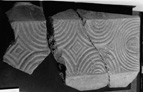
Object type: Grave-cover, in three joining pieces [1]
Measurements: L. 122 cm (48 in); (W. 64 cm (25.2 in); D. 14.5 cm (5.7 in)
Stone type: Limestone, with a very fine-grained blue-grey to pale greyish-brown matrix, packed with Viviparid gastropod shells; Purbeck Marble, Durlston Formation, Purbeck Group, Lower Cretaceous, Isle of Purbeck
Plate numbers in printed volume: Ill. 362
Corpus volume reference: Vol 4 p. 233
(There may be more views or larger images available for this item. Click on the thumbnail image to view.)
The cover tapers, and the foot and lower right-hand side are lost. It is of fundamentally rectangular section, but the edges have a broad chamfer of concave profile. Only the upper face is carved.
A (top): On the vertical axis at what was presumably the head end is a low relief human mask. The square-ended, parallel-sided nose, linked eyebrows, eyes, and mouth, are indicated by incised lines. Enclosing the mask are six closely-spaced concentric semicircular mouldings of half-round section. Along each long side are two similar groups of seven such mouldings, the outer element of each group touching those of its neighbours. The group to the lower right is largely lost, and to the lower left are the remains of a third such group. Each of the two subsidiary fields thus created on the central long axis of the cover is filled with nested concave-sided lozenges.
