Select a site alphabetically from the choices shown in the box below. Alternatively, browse sculptural examples using the Forward/Back buttons.
Chapters for this volume, along with copies of original in-text images, are available here.


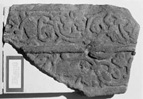
Object type: Grave-cover
Measurements: L. 70 cm (27.6 in); (W. 48 cm (19 in); D. 11 cm (4.3 in)
Stone type: Yellowish-grey, medium-grained (but with some 0.9 mm pellets), moderately shelly, oolitic limestone; probably Combe Down Oolite, Great Oolite Formation of Bath area, Great Oolite Group, Middle Jurassic
Plate numbers in printed volume: Ill. 363
Corpus volume reference: Vol 4 p. 234-235
(There may be more views or larger images available for this item. Click on the thumbnail image to view.)
It is parallel-sided, slightly coped, and roughly broken at each end. The upper break rises gently to the left before falling again. The lower break rises abruptly to the right from slightly to the left of the vertical axis. The right-hand edge of the stone has been vertically trimmed, but along the left-hand edge is a plain, low-relief border. Only the upper face is carved.
A (top): There is a half-round median moulding interlacing with an oval feature of similar section towards the upper end. In the fields to either side is heavily weathered foliate ornament. In each there is an undulating stem. Emerging from collars on it are subsidiary stems terminating in ragged acanthus leaves or flowers which fill the areas between the main stem and the edges of the field. At the lower end of the left-hand field is a bird in profile, facing to the right, having a hooked beak, and pecked eye. A pair of incised lines separate the leg from the body. The main stem crosses the bird's tail and wing tip, and from its beak issues a subsidiary stem crossing its neck to link with the foliage above.
No medieval church is known to have occupied the site of the New Examination Schools. Either the stone was brought here as building material, or it represents the site of a pre-Conquest burial ground which did not survive into the later medieval period.
The close comparisons which can be drawn between the inhabited plant-scroll on this piece, and those on works of the early tenth century, such as the Presentation Scene of the Vita Cuthberti (Temple 1976, no. 6, ill. 29), allow a similar date to be proposed for it.
