Select a site alphabetically from the choices shown in the box below. Alternatively, browse sculptural examples using the Forward/Back buttons.
Chapters for this volume, along with copies of original in-text images, are available here.


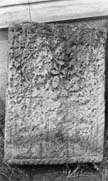
Object type: Grave-cover, in two pieces [1]
Measurements:
a: L.78 cm (30.75 in) W. 54 > 53 cm (21.25 > 20.75 in) D. 23 cm (9 in)
b: L. 76 cm (30 in) W. 50 > 48 cm (19.75 > 19 in) D. 23 cm (9 in)
Stone type: Both pieces display the same contrasting lithology: the upper half (with carved face) is a pale grey silty to sandy limestone including at least one patch of clustered ooliths; the lower half an orange-brown ferruginous silty fine sandstone (quartz grains less than 0.2mm diameter) with small ovoid hollows which may be moulds of bivalves, and some limonite veins. The two halves are in sharp contact along a near-flat slightly irregular plane, which is not a parting plane. The carved face is irregularly pitted as a result of present-day weathering. The orange-brown sandstone may be a product of much older (though geologically recent) sub-surface weathering, causing decalcification and oxidation of the upper part (as bedded) of what was originally throughout a pale grey, slightly ferruginous, silty to sandy limestone. Greetwell Member, Lower Lincolnshire Limestone of Lincoln vicinity
Plate numbers in printed volume: Ills. 187–9
Corpus volume reference: Vol 5 p. 172-175
(There may be more views or larger images available for this item. Click on the thumbnail image to view.)
The two stones are non-conjoined pieces of a flat tapering grave-cover decorated on its upper surface only and in a combination of low relief and incised work. Because of their present weathered condition, description of their detailed decoration relies on drawings done soon after their discovery (London, Society of Antiquaries, Brown Portfolio, Lincolnshire, p. 72; Jarvis MS, p. 64, drawing; Jarvis 1849, fig. facing 400). A drawing in Romilly Allen's collection is only a copy of that published (BL, Add. MS 37550, f. 784).
Stone 1a.
A (top): The border is defined by a finely executed single cable moulding. The central area contains a square cross of type A1, each arm of which extends to the border. Its outline is emphasised by a single cable moulding, slightly finer than the outer border: the intersection of the cross-arms is marked by a small round boss. Above the cross-arms are symmetrical confronted bird-like creatures that are scaled to fill the available field. Their bodies are rendered in a stylised ribbon pattern of a return-loop type (cf. Cramp 1991, fig. 25 Bvi), analogous to those found immediately below the cross-arm: it is based on a central oval pointed at the top and worked out into a head with the semblance of a hooked beak. Interlinking ovals to either side are elongated downwards into points to form large wings, and there is a horizontal double-ribbon binding across the centre of the body. Between the pointed ends of the wings a fan of tail feathers is represented as four radial segments, in a pattern that echoes the splayed foot of the cross on stone 1b. On either side immediately below the cross-arms, similarly filling the available space, is a ribbon pattern of circular or return-loop type comparable with Cramp 1991, fig. 25 Ciii and Civ, with a free pointed oval set vertically running through it.
B and D (long): Undecorated: a shallow rebate 14 cm (5.5 in) broad, running the length of the lower arris ofD, results from secondary use of the stone.
C (end): Undecorated.
E (end): Split for secondary use.
F (bottom): Roughly trimmed original surface, with rebate on arris with D.
Stone 1b.
A (top): The border is defined by a single cable moulding, which has been removed by damage along the cover's lower end. The central area is divided longitudinally by the lower cross stem, also marked by a single cable moulding, which splays out to the full width of the field. The splayed foot is articulated by a pair of triangular panels in relief outlined by an incised border. Paired on either side of the cross stem are two further decorative elements filling the available space: below is a triquetra (Cramp 1991, fig. 25 Bi) and above a simple square interlaced pattern in a cross form that is truncated by the splitting of the stone for secondary use. It can still be discerned that the latter motif was incised and not in relief as the early drawings suggest.
B and D (long): Undecorated.
C (end): Split for secondary use.
E (end): Damaged but undecorated original end of the cover.
F (bottom): Roughly trimmed original surface.
This is the most individualistic and stylish grave-cover in the county, and a rarity of its date in the country. Its originally fine execution and finish underline this standing. It is all the more surprising and significant, therefore that a second cover of practically identical form and decoration is known from Lincoln (City, Broadgate 1; Ill. 231), showing a more organised and standardised production industry than might have been anticipated. That production seems likely to have been Lincoln-based, where St Mark 6 (Ill. 243–4) is a much simplified and derived version (cf. Chapter V). The 'siltstone' stone type, which is common among the St Mark's material, reinforces this probability.
The cover's decoration, exceptionally, is distinctive of Viking-age sculpture. It exhibits this in two ways. First, the birds above the cross-arm are rendered in a sub-Borre, i.e. a specifically Scandinavian-based, style (Wilson and Klindt-Jensen 1966, 87–94), through assimilation of the bird form with the common Borre-style motif of closed ring-knots with a lenticular-shaped ring. They bear comparison in stone sculpture with interlace on the cross-head from St Mary Castlegate in York (Wenham et al. 1987, 160–3, pl. XXXII; Lang 1991, 96–7, ill. 305) and in metalwork with bronze strap-ends from St Mary Bishophill Senior and Coppergate (Hall 1976, 27; Roesdahl et al. 1981, 108, 121) or the bronze disc brooches or pendants from Saffron Walden (Doubleday and Page 1903, 329–31; Wilson 1964, 48–9) and other recent metalwork finds from East Anglia (Margeson 1997, 20–3). Though the origin of this motif, along with that of the Borre style itself, remains under debate (Duczko 1988–9), its popularity in the Scandinavianized areas of the British Isles and Ireland is indisputable. Borre style is in full flower in England in the early tenth century and lasts into the latter half of the century: its wide distribution across the Danelaw suggests that its currency may generally pre-date the re-conquest of this area (Wilson 1976).
The birds' stance may hark back to more naturalistic renditions of the pre-Scandinavian Anglian/Mercian tradition such as that on the stone cross-head from Brixworth, Northamptonshire (Wilson 1964, pl. IIb; Cramp 1986a, pl. XII). Though they lack the second, upper pair of wings of the Brixworth carving, the profiled head, wings folded downwards to a point, and a subdivided fan of tail feathers are all carried through. The symbol of St John in the Book of Cerne of the first half of the ninth century exhibits the same stance (Cambridge University Library, Ll. I. 10, fol. 31v – Alexander 1978, ill. 314), and the geometrically schematic eagle of St John in the Book of Dimma shows how the symbol was susceptible to stylised treatment (Alexander 1978, ill. 225). In their position, the birds allude to a long tradition of saints or angels (usually front-facing but occasionally confronted), often with downward pointing wings and rendered in a more or less stylised manner that gives them a bird-like appearance. In rare instances, such as the Epistles of St Paul from Würzburg (ibid., ill. 265) actual birds, symmetrically confronted, appear above the arms of a Crucifixion, as they do also in the capitals of the architectural frame of the Vespasian Psalter (ibid., ill. 146).
Perhaps the most relevant and contemporary parallel in a clearly Anglo-Scandinavian context, however, is found on the cross fragment from Leeds that depicts the hero Weland bound into his flying machine (Collingwood 1915, 217–18). The design, as Lang notes (Cramp and Lang 1977, no. 14), is quite symmetrical, and has a pointed oval framework, long symmetrical wings and a fan of tail feathers sub-divided in four (Ill. 491). Possibly, too, the very worn face of one of the cross-shafts from Pickering was intended as a similar motif (Pickering 2C: Lang 1991, 200, ill. 757; pers. comm. Dr Caroline Paterson). Though very unusual in the British Isles, interlaced birds with fan tails are relatively common metalwork motifs in Scandinavia and eastwards, in uses such as sword chapes and bridle equipment which have suggested a quasi-heraldic function (Ambrosiani and Erikson 1993, 12–13).
Secondly, the other circular or return-loop patterns on the cover fall into the category of motifs whose regular association with Scandinavian-derived ornament make them reliable Viking-period indicators and characteristic of Viking colonial sculpture (Bailey 1980b, 58–72; Bailey and Cramp 1988, 25; Cramp 1991, figs. 24–6). The combination of ring-knot and lozenge-shaped tie, paired beneath the cross-arms, is found on sculpture in York (Waterman 1959, fig. 10.10; Lang 1991, ill. 287), at St John's in Chester (Bu'lock 1958, fig. 3; id. 1972, fig. 15; Harris with Thacker 1987, fig. 39), and in an elaborated guise in Cumbria (Beckermet St John 3 and 4: Bailey and Cramp 1988, 58–9, ills. 67, 68) and in other media in the Scandinavian world. The knot survives into the twelfth-century repertoire in a multi-stranded form at Byton and at Llangarron, both Herefordshire (Gethyn-Jones 1979, pls. 23b and 40c).
The triquetra is a motif of pre-Viking Insular art that clearly survives into the tenth century. It is employed on hogbacks, as on the end panels at Plumbland, Cumberland (Bailey and Cramp 1988, ills. 535, 537) or on the side panel of one of the Brompton, Yorkshire NR, covers (Bailey 1980b, pl. 22), on tenth-century cross-shafts 4 and 7 at Sockburn, co. Durham (Cramp 1984, pls. 129, 707 and 134, 729), and in metalwork on the side panel of the silver house-shaped casket in the British Museum, dating to the early tenth century (Wilson 1964, 214–15, pl. XLIV; Backhouse et al. 1984, 34–5), or on an unprovenanced bronze pendant also of tenth-century date (Wilson 1964, 207–8, pl. XLIII).
The pair of square return-loop crosses to left and right of the cross-shaft find some echo in the 'buckle knot' on the cross-head at Kirkdale, Yorkshire NR (Collingwood 1911, 285). The scheme may have an iconographic as well as decorative function, providing a reference to the subsidiary crosses in a Calvary scene. This is certainly an iconographical scheme that spawns a local tradition, found more explicitly, for example, in grave-covers at Lincoln St Mark 7 and Howell 1 (Ills. 249, 220). The idea is reinforced by the motif within the splayed foot, that seems to represent a Calvary mound rendered in a style conforming with the rest of the decoration (e.g. with the vertical division representing a double ribbon tie). If so, it too appears to be the source of a local tradition exhibited in a simplified but recognisable form in such pieces as Lincoln St Mark 6 and Lincoln Cathedral 1 (Ills. 244, 230), that then develops into the U-terminal of Howell, Stallingborough and elsewhere (Butler 1964, 121).
The small boss at the junction of the cross-arms is distinctive and matches that on the marker from the same graveyard (Hackthorn 2, Ills. 191, 193). It may suggest that the two were designed to go together en suite. The marker is only just slightly (5 cm) wider, the cabling on its border is of a similar fine quality, and the stone type appears identical. Suggested associations between covers and markers have been made for several of the pieces in the Lincoln St Mark's collection (Stocker 1986a, 56–7).
If this cover does belong to the first half of the tenth century, rather than the second, when the parochial pattern on the Cliff north of Lincoln began to develop (cf. Chapter VIII), then it may indicate a special status for Hackthorn that is not otherwise evident.
