Select a site alphabetically from the choices shown in the box below. Alternatively, browse sculptural examples using the Forward/Back buttons.
Chapters for this volume, along with copies of original in-text images, are available here.


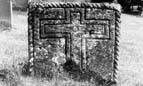
Object type: Grave-marker
Measurements: H. 62 cm (24.5 in); W. 57 and 60 > 59 cm (22.5 and 23.5 > 23.25 in); D. 18 > 15 cm (7 > 6 in) and 20 > 18 cm (7.75 > 7 in)
Stone type: A pellety oolitic limestone, with small shell fragments; apparently not a grainstone. Upper Lincolnshire Limestone, Inferior Oolite Group [but not Ancaster or Barnack types]a
Plate numbers in printed volume: Ills. 190–4
Corpus volume reference: Vol 5 p. 175
(There may be more views or larger images available for this item. Click on the thumbnail image to view.)
A complete upright rectangular grave-marker that stands orientated with broad faces east and west and earthfast as originally intended. A zone of roughened stone is just visible at ground level on both broad faces and all decoration terminates on it. Each face of the marker except C is very slightly tapered from the top down. Every surviving original surface is decorated.
A and C (broad): Identically decorated with a cable-moulded border that extends 50cm (19.75 in) down the arrises of the marker. On both faces a rectangular cross of type A1 and of very similar dimensions is defined by double incised lines of V-section, the outer slightly broader than the inner. The upper arm is short and abuts the border, the lateral arms are completed short of the border, the long stem fades out on a level with the border's termination. At the crossing is a small incised circular boss. On face A (west) a rebate visible on the right-hand (south-west) arris close to ground level and an adjacent area of surface damage indicate that the stone has been through a secondary use.
B and D (narrow) and E (top): The other faces have only the cable-moulded border.
This is one of the Lindsey group of closely similar rectangular markers found with a restricted distribution in Lincoln city and Lindsey (see Chapter V and Table 7A). Their similar distribution and occurrence at three sites with Lindsey-type covers suggests that they functioned as head-stones in grave suites with these covers. They may nevertheless equally have stood en suite with other forms of cover, as seems probable here. For Hackthorn 2 is only slightly (5cm/2in) wider than the cover, Hackthorn 1, the cabling on its border is the same fine quality, and the stone type appears identical. The cover has a similar incised circular boss at the junction of the cross-arms. This decorative detail the Hackthorn marker shares, too, with the finely produced example from Gayton le Wold (Ills. 180, 184), which is also double-sided and tapered in form and probably early in the group.
