Select a site alphabetically from the choices shown in the box below. Alternatively, browse sculptural examples using the Forward/Back buttons.
Chapters for this volume, along with copies of original in-text images, are available here.


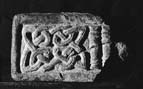
Object type: Part of impost or string-course, in four pieces now joined
Measurements: As reassembled: L.45 cm (17.7 in); W.26 cm (10.2 in); D. 19 cm (7.5 in)
Stone type: [Surfaces obscured by cement but probably Ancaster Freestone, Upper Lincolnshire Limestone, Inferior Oolite Group]
Plate numbers in printed volume: Ills. 204–8
Corpus volume reference: Vol 5 p. 180-182
(There may be more views or larger images available for this item. Click on the thumbnail image to view.)
The four fragments appear to have been correctly reassembled as a length of decorated string or impost. The reconstituted stone includes a return around a corner. In section the (presumably lower) angle is rectangular but the (presumably upper) face slopes slightly down-wards. The two horizontal panels of the display faces were bounded by a roll moulding which in places (notably along the lower arris) was decorated with cable ornament. The panels are both decorated in low relief.
A (long): The decoration on this face is in two distinct zones. Away from the corner of the panel at the angle of return, two incised balusters survive from what was evidently originally a much longer run. They have a pronounced bellied profile, and identical 'cubical' caps and bases are indicated by a carefully incised double moulding. Between the end of the run of balusters and the angle is a unit of well-executed interlace. The strands are of semicircular section and have an incised medial line. The unit has been reconstructed, apparently correctly, as a variant of turned pattern C with cross-joined terminals.
B (narrow): The other face preserves a fragment of what might be the hind quarters of a quadruped. If correctly interpreted, only the outline of the rear leg and the tail turned over the animal's back survive. It is possible, however, that this is merely a unit of interlace (a pair of terminal loops), from which the surfaces have been lost.
C (long) and D (narrow): Broken.
E (top): Plain, but bounded by a roll moulding on the two surviving edges.
F (base): Plain and weathered, but bounded by the remains of cable moulding on the surviving edge.
This string or impost provides a further example of the long tradition of baluster shaft carving which lasted throughout the Anglo-Saxon period (discussed by Baldwin Brown 1925, 257–66). The earliest in this series are very probably the homogeneous, lathe-turned, more or less parallel-sided examples, with many lathe-cut quirks, from Jarrow, Monkwearmouth and Hart which have been associated with late seventh- and eighth-century buildings in those places (Cramp 1984, 23–5). A second group of balusters was identified by Baldwin Brown belonging towards the other end of the Anglo-Saxon period. This group consists of large, sculpted (as opposed to lathe-turned) shafts, often with integral caps and bases, which all share similar bellied profiles and do not have the multiplicity of quirks (which are much more laborious to produce without a lathe). This later group includes East Midland examples at Earls Barton, Brixworth and Barton-upon-Humber (nos. 2–7 above). This group of shafts are quite securely dated by their architectural contexts to the later tenth and early eleventh centuries.
The Hough impost or string carries miniature representations of such baluster shafts, not the shafts themselves, and in this respect Hough 1 must be compared with a small group of similarly decorated imposts and string fragments from Northumbrian churches at Hexham, Jarrow and Simonburn (Collingwood 1927, 27–9; Cramp 1984, 25–6). In spite of the fact that the balusters depicted in these examples are of bellied profile and have miniature cubical capitals, just like the full-sized versions belonging to the later group, Collingwood associates these architectural miniatures with the early groups of parallel-sided balusters at Monkwearmouth, Jarrow and Hart, assigning the Hexham examples to Wilfrid's church and so suggesting a very early date for the other examples of architectural sculpture of this type.
By this reasoning the Hough impost or string should be dated to the seventh or eighth century. But we find such an early date very difficult to accept for several reasons. First, the Hough balusters (like those from the Hexham, Simonburn and Jarrow imposts) have very close parallels amongst the full-sized versions belonging to the later group (especially perhaps those at Brixworth) and nothing in common with the genuinely early lathe-turned examples at Jarrow, Monkwearmouth and Hart. This ought to suggest that a date in the tenth century should be preferred to one in the seventh or eighth for the Hough impost. Secondly, the interlace on Hough 1 face A would be hard to place in a seventh- or eighth-century context. Where such interlace motifs are found on imposts, a date in the post-Viking period is usually assigned (Taylor 1978, 1052–3; see also further examples at Hexham in Collingwood 1927, 27–9). Furthermore, the style of interlace cutting at Hough, with its semi-circular section, incised medial line and precise finish is paralleled locally only by good-quality interlace assigned in this volume to the tenth century, for example on the Cranwell 1 shaft (Ill. 106).
The site at Hough might be a contender for an early church as there is a major sixth- and seventh-century burial ground at Loveden Hill, one mile west (Fennell 1974; see Hough 2 below), and the later medieval parish was one of great extent including at least one parochial chapel at Brandon (Owen, D. 1975, 19). However, this is not, of itself, sufficient evidence to suggest a context for seventh- or eighth-century architectural decoration, which on other grounds we would wish to ascribe to the tenth.
In fact there is, within the site, a plausible architectural context for this impost sculpture of later tenth-century date. The tower of the present church is a well-known member of the Taylors' C1 group (i.e. it probably dates from the second half of the tenth century) and there is some evidence for a nave of this period also (Taylor and Taylor 1965, 321–4). It may therefore be suggested that the Hough impost or string is more likely to be of the tenth century, rather than the seventh or early eighth, and to be associated with either the surviving tower or its vanished nave. Unfortunately, we know little of the circumstances in which the four fragments were discovered in 1908, but they were apparently found in the vicinity of the tower and/or chancel arches.
Decorated imposts might be expected in such locations in a tenth-century building and so it may be that the fragments had not moved far from their original positions when discovered. They may, for example, have been used as rubble in blocking associated with the insertion of the doorway into the tower (in the thirteenth century) or the chancel arch when these structures replaced their original archways.
If these pieces are correctly identified as tenth-century decorated imposts then they are a rare category of architectural detail. The only complete parallel for impost blocks with such elaborate decoration would be the impost block in the north side of the chancel arch at Hackness, Yorkshire NR (Lang 1991, ill. 471). However, this important impost has often been suspected of being in a secondary position and this conclusion has recently been reinforced by Lang (ibid., 141), who notes that it has been greatly cut down to fit its present location and suggests that it may have originally been a grave-cover. The Hackness impost, then, cannot be seen as a good parallel for that at Hough, which is not suspected of being a reused component from an earlier feature.
The imposts at Hackness are also decorated with zoomorphic motifs which might have been comparable with the possible beast on face B at Hough. However, little survives of this beast, and anyway such hind quarters are not sufficiently date-specific to confirm an early date without supporting evidence; there are, for example beasts with not-dissimilar hind quarters associated with (though not carved on) the early eleventh-century imposts of the tower arch of St Benet's church, Cambridge.
There is, then, good reason to date the impost to the tenth century on the strength of the form of the balusters, and the survival of the small fragment of the hind quarters of a beast on the return need not challenge that date. Even if accepted as tenth-century, however, it represents an elaborate and rare architectural feature, which it is tempting to associate with the surviving tower.
