Select a site alphabetically from the choices shown in the box below. Alternatively, browse sculptural examples using the Forward/Back buttons.
Chapters for this volume, along with copies of original in-text images, are available here.


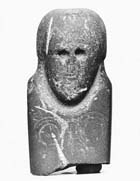
Object type: Whetstone/sceptre terminal
Measurements: L. 10.5 cm (4.25 in); W.at head 4.5 cm (1.75 in), at shoulders 5.5 cm (2.25 in), at break 5 cm (2 in); D. at forehead 4.5 cm (1.75 in), at break 3.5 > 2.2 cm (1.35 > 0.9 in)
Stone type: [The stone type was identified as a chloritic and micaceous sandstone by Mr W. Campbell Smith following thin sectioning at the British Museum (Natural History) at the instigation of R. L. S. Bruce-Mitford of the British Museum in 1956 (correspondence in Lincolnshire SMR, file reference 30280; Petch 1957, 18) and matched for possible source to a rock from Dumfries. Ellis's seminal study reclassified it within his sub-group IIB as a calcareous and micaceous greywacké-grit with abundant volcanic fragments, and provided a more thorough characterisation by reference to grain size and inclusions (1969, 158–9). This confirmed a probable parent rock with volcanic characteristics in the 'Scottish Southern Upland or Lakeland' as its likely source (ibid., 161–2).]
Plate numbers in printed volume: Ills. 209–14
Corpus volume reference: Vol 5 p. 182-186
(There may be more views or larger images available for this item. Click on the thumbnail image to view.)
This is the upper terminal from an exceptionally large tapered whetstone/sceptre. It is made from an unusual, presumably specially selected, piece of distinctive stone type imported from a distance, perhaps from a location that was itself deemed to be special. It is decorated with a terminal head and shoulders of human form in the round, and with faint incised embellishment. To unaided visual inspection, there is no surviving trace of paint or evidence of former attachments in metal or other material except for the drilled hole in the crown of the head. Apparently, no modern scientific examination has taken place, or testing for residues in the drilled holes, for example.
Structurally, the head is formed as a knob or ball 45mm in diameter, which is also the distance from the shouldering on the stone and the figure's shoulders to the top of its head. The head is supported on a thick neck worked into a tapering conical form, where the carving appears less carefully finished than elsewhere. The body of the whetstone below the shouldering is of a generally rectangular section (55 to 50mm by 35mm), but with both front and back faces slightly convex or bevelled in two adjoining planes with a dividing ridge, the front more markedly than the back. The arrises are rounded. The overall form is very slightly tapering down the stone away from the head in both width and thickness.
A (broad): From the front the head has an overall pear-shaped appearance imparted by an elongated chin worked in a rounded point. This is emphasised by a strongly worked broad groove that slightly undercuts the chin. The hairline is clearly marked above a high forehead by a continuous asymmetrical groove that gives the hair area a raised appearance. The prominent eyes are deeply drilled holes with approximately 6mm diameter; the nose is a simple rectangle and was formerly raised but has been levelled by old damage; the mouth is a straight incision. There is no indication of beard or moustache, but a slight rise at the side of the eyes mirrored by faint incisions above indicate prominent eyebrows.
A shallow groove looping down from one shoulder and back up to the other marks out the lower edge of the neckline. Below, the upper end of each of the slightly coped fields of the body of the whetstone is decorated with a compass-drawn triple incised circle with an external diameter of 23mm and approximately concentric, whose centring hole is visible. The lower sector of both these decorations is worn away by 'soft' handling that has rendered the surface below very smooth.
B (narrow): The left side has a similar incised concentric decoration to those on side A at the top of the main edge, on the figure's shoulder. Only two circles are clearly visible with an outer diameter of 15mm and a centring hole, but a third outer circle lost on the curve of the stone would give a similar overall size to the motif. From the centring downwards the stone's surface is exceptionally smoothed, perhaps by 'soft' wear of holding in the hand, almost removing all traces of the whole lower half of the incised circles.
On the head, there is no indication of an ear, which is presumably hidden by the hair. The hairline is strongly marked by a near-horizontal asymmetric groove, that makes the hair area raised. Detail of the hair is indicated in the forward half of the field by a swag of multiple roughly parallel incised lines lying along the front hairline; these appear to loop back round on themselves to form a distinctive curl of hair. In contrast, wherever the stone surface survives to the lower rear of the head the hair is marked by massed vertical incisions. Much of the upper part and side of the head has its surface systematically damaged by percussion, which in turn pre-dates a series of plough strikes.
C (broad): At the back, the head has severe systematic damage to the whole surface by percussion, that again pre-dates plough strikes. Faint vertical massed incisions are visible wherever surface survives towards the hairline.
Below the neck, the top of the rear surface is marked by shallow grooves forming a pair of arches, one matching each coped surface of the stone. Triple concentric circle motifs are fitted in below each arch, each with a clear centring hole and an overall diameter of approximately 22–23mm. They are similarly but not uniformly executed, and are marginally lop-sided, the right-hand one positioned higher on the stone.
D (narrow): The right side is virtually identical with B. On the head the systematic percussive damage is very extensive. Hair detail in the forward half of the field is indicated by two roughly incised parallel lines following the hairline, which appear to turn back on themselves to form a curl. On the body, an incised line marks the top of the shoulder. Only the top quadrant of a triple concentric circle motif and a centring hole below it is visible. The remainder is worn away by 'soft' handling which has rendered this edge surface exceptionally smooth.
E (top): The top surface is thoroughly and systematically removed by percussion, pre-dating plough strikes, that covers the whole top, fading out to the front but continuing especially down onto the back and both sides. A drilled hole of approximately 7mm diameter and about 20mm deep is not central to the head but, because the head is lop-sided, is in relation to the central line of the stone. Its top edges have been broken away by the secondary hammering or grinding, which it therefore pre-dates.
F (bottom): Old broken surface, with a small fresh break at one edge exposing the micaceous core of the stone and repaired scar of thin sectioning.
Surprisingly, this exceptionally impressive and unusual object has not been described systematically since the brief note marking its original discovery (Petch 1957, 17–19), and practically all discussion of it has been as a comparandum for other objects, principally the whetstone/sceptre from Sutton Hoo in Suffolk.
Though finely made and an ostentatiously impressive object, it is not perfect in layout or execution. Most notably, the knob-like head is cut lop-sided, inclined to the right, in relation to the lie of the stone, and this affects the set of the shoulders. This appears to account for the off-centre location of the drilled hole in the crown of the head, and suggests, contrary to initial appearance, that it is an original feature. If so, it may have been the fixing point for a finial, analogous to that which embellishes the whetstone/sceptre from Sutton Hoo or the animal finials on other overtly ceremonial objects in the Anglian midlands such as the seventh-century display helmets at Benty Grange in Derbyshire and newly in 1997 at Wollaston in Northamptonshire. A purely functional suspension loop is implausible both because of the stone's overtly ceremonial status and because of its likely original size and weight. But one alternative possible form or component of a finial might nevertheless have been a metal loop (as at Sutton Hoo), symbolic rather than functional in the manner of a small whetstone, reinforcing the bar's emblematic association as an object of power and authority with the tool – the whetstone – with which warrior leaders sharpened their swords.
The full original size and form of this object is unknowable without additional discoveries. The analogy of its closest comparanda both in respect of stone type or source and function, namely the Sutton Hoo whetstone with a length of 58.3cm (Bruce-Mitford 1978, 312) and that from Uncleby in Yorkshire at 46.3cm (Evison 1975, 79), may suggest that the Hough bar might have been at least 40cm long. Both of those are closer to rectangular in section, but with a lesser maximum thickness than the Hough bar; it probably therefore was of comparable massiveness, as was evidently appropriate to its specific purpose. It tapers slightly away from the head. This identifies the surviving piece as the top end, but in itself neither proves nor precludes the view that the whetstone was single-ended, i.e. was undecorated at its narrower terminal.
This last consideration need have no bearing on the object's interpretation as a whetstone/sceptre, or its likely dating to the seventh century. As a type of object, it invites comparison not only and most tellingly with the whetstone/sceptre from Sutton Hoo, but also with the undecorated but large, unused and therefore plausibly ritual whetstone from Uncleby (Evison 1975). Both have a secure seventh-century burial context, and their manner of deposition in both cases in a vertical position adds weight to the several other considerations pointing to their ritual importance. These three bars are further linked by their close commonality of stone type and its distant source (Ellis 1969, 158–62; id. 1978); and significantly three further whetstones most closely matching this stone type also come from pagan Anglo-Saxon cemetery contexts, that include grave 24 at Fonaby in Lincolnshire – a male grave and considerably the most richly equipped in that cemetery, dated by a buckle set to the later sixth-century or later (Cook 1981, 26–28).
As Bruce-Mitford has shown (1978, 350–7), a knobbed or ball-like terminal, with or without an additional finial, is a significant symbolic element in sceptres, not least in evoking the Antique tradition. The structure of the Hough terminal demonstrates a clear awareness of this. Indeed the elaboration of hairstyle evident in the incised curls at the temples may suggest an aspiration, at whatever remove, to reproduce the styles of Roman portrait busts. Recent discussion of the potential significance of the Sutton Hoo sceptre as a symbol of Roman consular rank (Filmer-Sankey 1996) may make such an aspiration more plausible.
Fennell's commentary on this object took a style-critical and aesthetic view that emphasised the supposed 'sombre' and Celtic quality of the head (Fennell 1964, 161–2, 169), and it may be this sort of generalised analogy with the extensive Celtic tradition of detached or emphasised heads in stone, wood and metal that caused Bruce-Mitford to hold open the possibility of an Iron Age date for the Hough whetstone (Bruce-Mitford 1978, 364). Considerations of a Celtic cultural and political contribution to Sutton Hoo and to Germanic kingship in England (e.g. Enright 1983) may also play a part, though not a chronological one. In practice, apart from the primary argument for the stone's dating set out above, the stylistic case adequately supports an early Anglo-Saxon context. Not least relevant are its direct similarities, noted by Fennell himself, with the head of the anthropomorphic figure decorating the embossed bronze work from the bucket excavated from the major Anglo-Saxon inhumation and cremation cemetery at Loveden Hill in Hough-on-the-Hill parish in 1955–9 (Wilson and Hurst 1959, 297; Fennell 1964, 150–169). Such heads or human 'masks' indeed form part of the routine repertoire of later pagan metalwork, of which the later sixth-century square-headed brooch from Nettleton, found in 1987, is a fine but unexceptional local example (Field 1988, 85). The shape of the lower face, rectangular-plan nose and emphasised eyebrows in some ways recall the face-mask of the Sutton Hoo helmet. The drilled eye-sockets were presumably intended for inserts in a different material, which (for what it is worth) would have considerably alleviated any expressionless 'sombreness'.
But it is the Sutton Hoo whetstone/sceptre that offers the most apposite comparison, and contrast, for the head, too. Some of the heads there are unambiguously male (being bearded) and others more androgenous, or even female. The criterion of beardlessness would make the Hough figure female, too, and the hairstyle might be additional supporting evidence. There, the individual characterisation across the range of heads has itself led to the suggestion that they represent the ancestors of the owner, or of the political grouping, or both (Bruce-Mitford 1978, 370–7); the idea is not immediately transferable to Hough, since neither is the figure distinctively identifiable nor is the dynastic context clear (but see below for the possible relevance of the Loveden Hill cemetery). At Sutton Hoo, too, the heads are all isolated from the body of the stone itself by a bold frame; they are, in effect, applied decoration. The Hough-on-the-Hill bar, by contrast, is conceived of as the body of the figure whose head appears at the top. In this respect it might be thought to be closely paralleled by what has also been taken to be a ceremonial whetstone terminal from Lochar Moss, Collin, near Dumfries (Laing 1973, 46, 51–2; Bruce-Mitford 1978, 364–9), though this, like several small examples from elsewhere in Scotland, Wales and Ireland (Bruce-Mitford 1978, 368), is undated and is not carved in the round.
The concentric compass-drawn circles are also part of the Anglo-Saxon metal- and bone-workers' repertoire. A notable Lincolnshire example is the bronze hanging bowl from Caistor (Bruce-Mitford 1993, 50–1, pl. 2).
In summary, the Hough-on-the-Hill whetstone is a member of a very rare class of object of a distinctive ceremonial character. It may include essentially undecorated examples like that from Uncleby, particularly in view of their size and common, remote source (Evison 1975). Setting aside the small examples from the Celtic west and north, which may anyway be of later medieval rather than earlier date, only the stone from Lochar Moss has carvings of comparable type and quality to those at Hough-on-the-Hill and Sutton Hoo. Furthermore the stone type also links these three examples together. The Lochar Moss example is 'a greywackeé-grit without grains of volcanic rocks... [but] ... with abundant calcite' of a type locally available, and groups with the others in Ellis's sub-group IIB (Ellis 1969, 161–2). Given this uniformity of material, it is reasonable to allocate the three whetstones decorated with finely carved heads a similar date-range. Although of the three only that from Sutton Hoo is from an undoubted seventh-century context, then, we should probably expect both of the other two to date from a similar period.
But Hough-on-the-Hill, like Sutton Hoo, is a location which was clearly of great significance at the relevant date, as demonstrated by the size and complexity of the Loveden Hill pagan cemetery within the parish and its distinctively prominent situation. Successive campaigns of excavations have confirmed the importance of this cemetery, and mark it out as the most exceptional sixth- and seventh-century burial ground in Kesteven. It included a number of richly furnished graves, some under barrows, and it continued in use until at least the late seventh century (Meaney 1964, 158–9; Fennell 1964; Fennell 1974, 285–6; Webster and Cherry 1973, 146: the archive from the various excavations at the cemetery is in Lincoln City and County Museum and is currently being assessed for publication by English Heritage). Among other special artefacts, it has produced a fine Coptic bowl and three hanging bowls, which also relate it to seventh-century cemeteries of the highest status, such as Sutton Hoo (Page and Field 1986, 76–7; Bruce-Mitford 1993, 54).
Contra Meaney (1964, 158), Laing (1973, 46) and Leahy (1993, 40), for example, and successive British Museum Sutton Hoo handbooks (Bruce-Mitford 1968; 1972; 1979), the find-spot for the whetstone terminal was neither the Loveden Hill cemetery site, located one mile west of Hough-on-the-Hill village, nor a grave (though both may arguably be the correct primary provenance). Rather, it lay more than half a mile north-east of the village, nearer to Frieston than to Hough and too far distant for it to be a marginal mislocation. It was, however, a secondary deposition following a secondary use for the surviving stone fragment that is clearly reflected in its surface damage. This use was as a percussive tool or as a grinding tool in the manner of a pestle or perhaps both. This entailed its being grasped by the stub of the bar in a way that gave rise to the marked wear and smoothing from soft handling that are most evident on the edges of the bar. The face was held upwards, which therefore concentrated the percussive or abrasive wear on the top and back of the head and the upper parts of its sides. Particularly if the last phase of this secondary use was as a handy percussive instrument in agricultural fieldwork, there is no reason to suppose that the location of its final, casual loss was related to any habitation still less any cemetery site. Prior to this secondary use, on this reconstruction the stone might in principle have come from anywhere, not necessarily locally. But in practice the coincidence of an object comparable to Sutton Hoo material found within a couple of miles of the southern Lincolnshire cemetery most similar in characteristics to Sutton Hoo is overwhelming. The stone's most likely primary provenance is no doubt the cemetery site on Loveden Hill, with its richly equipped late pagan burials in and around a focal barrow. Indeed, had the original ceremonial whetstone been ritually interred in a vertical orientation, as evidenced at both Sutton Hoo and Uncleby, it might easily have suffered just the sort of breakage of its upper terminal, for example from ploughing, that gave rise to the surviving stone.
Were we to presume that the whetstone terminal did come from one of the rich burials in the Loveden Hill cemetery, an individual of considerable importance is probably denoted. Even if regarded purely as a symbolic whetstone (of the type documented in Evison 1975), rather than as a sceptre, its owner must have been of pre-eminent status locally, and the whetstone may itself have been the primary symbol of that status. If we accept the Sutton Hoo sceptre's being a symbol of Roman consular rank (Filmer-Sankey 1996), we might expect its local equivalent to have been bestowed by the quasi-imperial power – ?the bretwalda – primarily to a sub-king.
