Select a site alphabetically from the choices shown in the box below. Alternatively, browse sculptural examples using the Forward/Back buttons.
Chapters for this volume, along with copies of original in-text images, are available here.


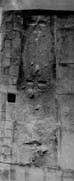
Object type: Grave-cover
Measurements: L. 209 cm (82.25 in) W. 65 > 42 cm (25.5 > 16.5 in) D. Built in
Stone type: [Barnack Rag type, Upper Lincolnshire Limestone, Inferior Oolite Group]
Plate numbers in printed volume: Ill. 402
Corpus volume reference: Vol 5 p. 280-281
(There may be more views or larger images available for this item. Click on the thumbnail image to view.)
A very large, complete, tapering and slightly coped grave-cover. Only one face is visible.
A (top): Decorated with a narrow raised stem of square section running the length of its ridge, on which three unusual cross motifs in relief are disposed, one at the head, one at the foot and one in the centre. Each motif is made up of a short rectangular cross-bar and wedge-shaped arms in the form of a 'bow-tie' or bobbin lying along the stem (a combination of types A1 and B6).
Appendix A item (stones dating from Saxo-Norman overlap period or of uncertain date).
Butler (1964, 119) associated the pair of wedge-shaped cross-arms, which he termed a 'double-axe' type, with that group of small covers decorated with multiple geometrical incised lines forming lozenges, including examples from Crowland, Sleaford, South Kyme and Whaplode within Lincolnshire, and Ketton beyond. These he identified as an early post-Conquest transitional stage of Barnack products, dating from the last decades of the eleventh and early decades of the twelfth century.
In practice, Ingoldmells 1 stands in contrast with all these examples in its use of the 'bow-tie' or bobbin motif rather than lozenges. This occurs northwards at Stallingborough 1 (Ills. 427–8) but on a poor local stone-type: more pertinently at Castor and Ufford in the Soke of Peterborough 'bow-ties' are associated with tridentine arms on covers in local Barnack stone. A further link with that Barnack tradition is this piece's deployment of a triple cross motif, such as structures many of the typical interlace covers of the Cambridge region and of Peterborough (Fox 1920–1), and its use of what can read as a hybrid cross form, part type A1 part type B6, as occurs in local south Lincolnshire covers such as Castle Bytham 1 and Carlby 2 (Ills. 88, 84). Its stone type, certainly Barnack, would confirm the identification with the group.
