Select a site alphabetically from the choices shown in the box below. Alternatively, browse sculptural examples using the Forward/Back buttons.
Chapters for this volume, along with copies of original in-text images, are available here.


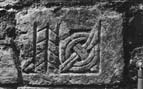
Object type: Part of grave-cover, in two non-adjacent pieces [1]
Measurements:
a: L. 46 cm (18 in) W. 34 > 32 cm (13.5 > 12.5 in) D. Built in
b: L. 58 cm (22.75 in) W. 30 > 28 cm (11.75 > 11 in) D. Built in
Stone type: [Ancaster Freestone, Upper Lincolnshire Limestone, Inferior Oolite Group]
Plate numbers in printed volume: Fig. 9; Ills. 221–2
Corpus volume reference: Vol 5 p. 189-190
(There may be more views or larger images available for this item. Click on the thumbnail image to view.)
Two non-conjoining pieces probably from the same flat-topped chest-like grave-cover of mid-Kesteven type. Their appearance, workmanship, decoration and stone type are very similar. In all likelihood they come from either end of the same flank of the cover, which tapered slightly in a manner common to this monument type.
B (long): Stone 1a is decorated in low relief on its only visible face with two panels filled with interlace with an incised medial line. The panels are separated by a double cabled border making effectively a vertical chevron band. The interlace in the complete vertical panel is in the form of motif i (Fig. 10). The second panel is truncated by the broken end of the stone: what survives appears to be the end of a run of three-strand plait, probably forming a long central panel. The borders are broad and plain: they are of unequal widths, the broader being the lower edge of the cover. There is a wide undecorated space between the complete panel and the end of the stone, which is also the end of the cover.
Stone 1b is a mirror image of the decoration of 1a. Rather more of the three-strand plait of the long central panel is preserved on its greater length.
Both the style and design and layout of the surviving decoration make it certain that these pieces come from the same large cover of mid-Kesteven type (Chapter V). Motif i is also found in this group on examples at Aisthorpe (Ill. 9), Bassingham (Ill. 34) and Burton Pedwardine (Ill. 73). What is missing is a further stone of approximately similar dimensions that would have on it the remainder of the long central panel of this flank of the cover, with a central 'bull's head' and interlace to complete a symmetrical pattern.
In location this is the furthest flung of the covers of mid-Kesteven type. It presumably reflects riverine and coastal water-borne movement (Fig. 12).
