Select a site alphabetically from the choices shown in the box below. Alternatively, browse sculptural examples using the Forward/Back buttons.
Chapters for this volume, along with copies of original in-text images, are available here.


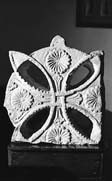
Object type: Cross-head
Measurements: H. 42 cm (16.5 in); W. 40 cm (15.75 in); D. 17 cm (6.75 in)
Stone type: [Probably Ancaster Freestone, Upper Lincolnshire Limestone, Inferior Oolite Group]
Plate numbers in printed volume: 458–9
Corpus volume reference: Vol 5 p. Vol 5 p. 326
(There may be more views or larger images available for this item. Click on the thumbnail image to view.)
Loose at west end of nave
Found 'recently', before 1929, reused as a walling stone in Keddington church (Cresswell 1928–9, 257). Local tradition claims that it comes from the nearby site of the Cistercian abbey of Louth Park, founded 1139. Architectural masonry probably from Louth Park is visible elsewhere in the church (Pevsner and Harris 1964, 283).
Very good. The head has been recut on two sides at right angles for reuse and one of those sides has a narrow chamfer. The original top survives and is identifiable by its differential weathering. The same orientation is indicated by the balance and organisation of the decorative details.
The greater part of a cross-head with finely executed decorative detail. In basic form it is a solid disc. Both broad faces are decorated with the same raised closed-circuit pattern, similar to that in Cramp 1991, fig. 24C second from bottom, but laid out so that there is an open square at its centre. Where the points of the pattern protrude from the disc they are carried through as solid 'ears' to the opposite face but the areas enclosed by the loops are pierced. The solid areas between form expanded arms of cross pattée type, with narrow raised fillets at the terminals, traces of two of which survive.
A (broad): The strands of the closed-circuit loop are enriched with continuous zig-zag along their inner edges. In each quadrant between the loops is a large multipetalled rosette of 20 points, which in the upper quadrant is additionally flanked by symmetrical fronds from a leaf pattern. Beneath the square centre of the closed-circuit loop is a cross with expanding triple-leaf terminals that extend into each quadrant. Again the upper terminal is distinctively more elaborate.
C (broad): The reverse face matches A in layout but is much simpler in decoration. The strands of the loop are not ornamented: there is no central cross. In the quadrants a simpler six-petal rosette survives in the upper, and scars may indicate where presumably identical decoration has been removed by recutting.
Appendix G item (the continuing tradition).
This finely detailed and executed cross-head must be of later twelfth-century or later date if its provenance is indeed the abbey of Louth Park. Its decorative details of zig-zag, rosettes, foliate-terminal cross, and particularly the distinctive fragments of leaf pattern would suit a later twelfth-century date. Ryder 1991 offers several formal parallels to the cross-head type. Its protruding 'ears' find an analogy in a group of grave-markers found in north Kesteven at North Rauceby (no. 3, Ills. 420–3) and Grantham (the latter a cross patt´e, see Appendix F [separate PDF]). Its most important analogy lies in Castle Bytham 2 (Ills. 450, 452), where both cross type and rosettes are found decorating a shaft in the pre-Conquest tradition. The small size of Keddington 1 means that it might as probably be from a marker as a shaft.
Cresswell 1928–9, 257–8 and fig.; Pevsner and Harris 1964, 283; Pevsner et al. 1989, 411
