Select a site alphabetically from the choices shown in the box below. Alternatively, browse sculptural examples using the Forward/Back buttons.
Chapters for this volume, along with copies of original in-text images, are available here.


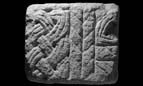
Object type: Part of grave-cover
Measurements: L. 41 cm (16.1 in) W.36 cm (14.2 in) D. 31 cm (12.2 in)
Stone type: [Ancaster Freestone, Upper Lincolnshire Limestone, Inferior Oolite Group]
Plate numbers in printed volume: Fig. 9; Ills. 216–18
Corpus volume reference: Vol 5 p. 190-191
(There may be more views or larger images available for this item. Click on the thumbnail image to view.)
A fragment from one end of a large grave-cover of mid-Kesteven type. The stone has been recut to form a section in a sub-circular angle shaft in a secondary use. For that reuse one side panel and one end have been cut back by about 5cm, whilst the stone itself represents about one third of the original cover and was probably split off from the remainder during this phase of reuse. Original decoration in low relief survives only on faces A and B.
A (top): This face represents one end of the lid of the cover and the decoration includes an almost complete transverse panel with an interlace knot (motif x, Fig. 10) with a double incised medial line. This panel is separated from those beyond it by a double cable-moulded border, below which is the upper terminal of a cross, which would have occupied the central panel of the lid. To either side of this terminal are the upper parts of small interlace knots with a double incised medial line. Decoration on the lid is bound by an undecorated fillet along the surviving arris.
B (long): The decoration here is largely missing, through both a trimming of the surface and subsequent weathering. All that can be seen today is a pattern of holes representing the interstices in a simple pattern of interlace disposed to form an upright panel towards the end of the block. The interlace was a knot of four-strand interlace (perhaps motif vi, Fig. 10) but little else can be said about it.
F (bottom): The roughly cut surface may represent the original base of the grave-cover.
The decoration on this stone clearly marks it out as a characteristic example of the mid-Kesteven group of covers (Chapter V). About one third of the original monument is represented and its relationship to the whole can be reconstructed as in Fig. 9. This large group of monuments is dated to between the mid tenth and the early eleventh century.
Although the sketchy documentation surrounding this stone may indicate that it came originally from Cately Priory, it must also be possible that it was in the vicarage garden before 1887. The small church at Kirkby Green was taken down and rebuilt in 1848, in a very antiquarian spirit (Pevsner and Harris 1964, 586), and many fragments from the church were retained in the adjoining village of Scopwick; it may be that the monument was discovered then. Certainly the place-name suggests that the location should have an earlier church presence than the thirteenth-century material which is, otherwise, the earliest known from the settlement.
